


If you work with others, sooner or later you will almost inevitably face the need for conflict resolution. You may need to mediate a dispute between two members of your department. You might feel angered by something a colleague reportedly said about you in a meeting. Or you may need to resolve a conflict with a client over a missed deadline. In organizational life, conflict is unavoidable—and effective conflict management tools are essential.
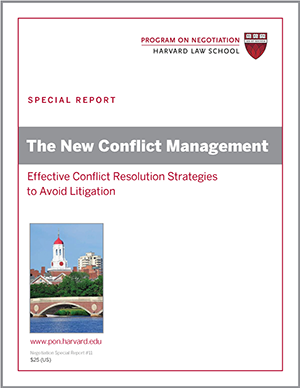
Claim your FREE copy: The New Conflict Management
In our FREE special report from the Program on Negotiation at Harvard Law School - The New Conflict Management: Effective Conflict Resolution Strategies to Avoid Litigation – renowned negotiation experts uncover unconventional approaches to conflict management that can turn adversaries into partners.
What Is Conflict Resolution?
Conflict resolution refers to the informal or formal processes that two or more parties use to address disagreements and reach a peaceful, workable solution. In the workplace, conflict resolution aims not only to end disputes but also to preserve relationships, maintain productivity, and reduce the emotional and financial costs of ongoing conflict.
Why does conflict escalate so easily? A number of common cognitive and emotional traps—many of them unconscious—can intensify disagreements and increase the need for formal conflict resolution.
Common Traps That Fuel Workplace Conflict
Several predictable patterns tend to make conflicts harder to resolve:
- Self-serving fairness interpretations. Rather than judging fairness from a neutral standpoint, we tend to define what is fair in ways that benefit us—and then justify those preferences as objective. Department heads, for example, may each believe they deserve the largest share of a limited budget. These competing fairness claims often lead directly to conflict.
- Overconfidence. People are frequently overconfident in their judgments and predictions. In disputes, this bias can lead parties to overestimate their chances of winning a lawsuit or “being proven right,” causing them to reject negotiated solutions that would save time, money, and relationships.
- Escalation of commitment. Whether dealing with a labor dispute, a merger disagreement, or an interpersonal conflict at work, parties often double down on failing strategies. After investing time, money, or pride, they feel compelled to justify those past investments—even though such “sunk costs” should not influence future decisions.
- Conflict avoidance. Because strong emotions are uncomfortable, people sometimes avoid addressing conflict altogether, hoping it will fade on its own. In reality, unaddressed conflict often deepens over time, making resolution more difficult and costly when it can no longer be ignored.
- Negotiation. Negotiation is often the first—and most flexible—approach to conflict resolution. The same collaborative principles used in dealmaking apply here. Effective negotiators seek to uncover the interests underlying each party’s stated positions, such as a desire to avoid negative publicity or to repair a strained working relationship. Negotiation also requires a clear understanding of your best alternative to a negotiated agreement, or BATNA—what you will do if no agreement is reached, such as finding a new partner or pursuing legal action. By brainstorming options and exploring tradeoffs across issues, parties can often reach a mutually acceptable solution without involving third parties.
- Mediation. In mediation, disputants work with a trained, neutral third party who helps facilitate dialogue and problem-solving. Rather than imposing a decision, mediators encourage parties to explore their underlying interests and communicate more effectively. Professional mediators may meet with parties together or separately, guiding them toward a resolution that is voluntary, nonbinding, and designed to be durable over time. Mediation is particularly useful when relationships matter and parties want to retain control over the outcome.
- Arbitration. Arbitration resembles a simplified court proceeding. A neutral arbitrator hears arguments and evidence from each side and then renders a decision that is typically binding and confidential. Although arbitration decisions generally cannot be appealed, parties often have flexibility in designing the process, including selecting the arbitrator, determining whether lawyers will participate, and agreeing on rules of evidence. Arbitration can be faster and less public than litigation, but it also limits parties’ control over the final outcome.
- Litigation. In civil litigation, a plaintiff and defendant present their case before a judge or a judge and jury. Evidence and arguments usually become part of the public record, and legal counsel plays a central role throughout the process. Litigation is often the most formal, time-consuming, and expensive conflict resolution method. Notably, many lawsuits end in negotiated settlements during the pretrial phase, after parties gain a clearer sense of their risks and costs.
Given these and other pitfalls, how can you create a constructive conflict resolution process when dealing with conflict at work in other professional settings?
Approaches to Conflict Resolution
Conflicts can be addressed in several ways, depending on their complexity, stakes, and relationship dynamics. Common conflict resolution methods include negotiation, mediation, arbitration, and litigation.
Choosing the Right Conflict Resolution Process
In general, it makes sense to begin with less formal and less costly approaches—such as negotiation and mediation—before committing significant time and resources to arbitration or litigation. Investing in conflict-resolution training can further strengthen your ability to manage disputes effectively, helping you address conflict early and resolve disagreements before they escalate.
What conflict resolution methods have you tried before? Leave us a comment.
Claim your FREE copy: The New Conflict Management
In our FREE special report from the Program on Negotiation at Harvard Law School - The New Conflict Management: Effective Conflict Resolution Strategies to Avoid Litigation – renowned negotiation experts uncover unconventional approaches to conflict management that can turn adversaries into partners.



Conflict resolution is essential in any workplace because disagreements are unavoidable. What stands out is how emotional and cognitive biases—like overconfidence or avoiding tough conversations—can make simple issues worse. Starting with negotiation or mediation instead of jumping to legal action often saves time, money, and relationships. Managing conflict early is always better than managing damage later.
This article clearly explains why conflict is inevitable at work and why structured resolution processes matter. I appreciate how it connects common psychological traps—like overconfidence and escalation of commitment—to real workplace disputes. The breakdown of negotiation, mediation, arbitration, and litigation also makes it easy to understand when each method is appropriate. Overall, it reinforces that effective conflict resolution isn’t just about ending disagreements, but about preserving relationships and long-term productivity.
This is a very practical and well-organized explanation of conflict resolution. I like how it not only defines what conflict resolution is, but also explains why conflicts escalate through cognitive biases like overconfidence and escalation of commitment. The breakdown of negotiation, mediation, arbitration, and litigation makes it easy to understand when each approach is appropriate. It’s a helpful reminder that addressing conflict early can protect both relationships and productivity in the workplace.
Conflict resolution can be the guided line to effectively work as a team in a polite and respectful way.
Conflict resolution arise due to dispute between two parties involved in any trade , it can be solved with fair negotiation or through Mediator or through arbitrator or through litigation.
Wondful work keep up pls.
Conflict resolution is way of settling misundestanding between two or more bodies on a matter through dialog.
Conflict Resolution can also be defined as a strong will and determination to create solution to a misunderstanding between two or more parties