Executive Education from the Program on Negotiation (PON) at Harvard Law School is a portfolio of courses that prepares participants to negotiate stronger agreements, mediate disputes, and manage conflict.
Taught by leading Harvard faculty and field experts, the offerings range from one-day sessions to semester-length courses. Participants join from around the world, across the profit and non-profit sectors, and from industries including business, government, law, and education.
IN-PERSON
Led by mediation experts Audrey Lee and Alain Lempereur, the Harvard Mediation Intensive delves into mediation principles and processes through interactive presentations and hands-on exercises. From employment and business disagreements to public and international conflicts, you will discover effective ways to enable parties to settle their differences across a variety of contexts. … LEARN MORE ABOUT THIS PROGRAM 
IN-PERSON
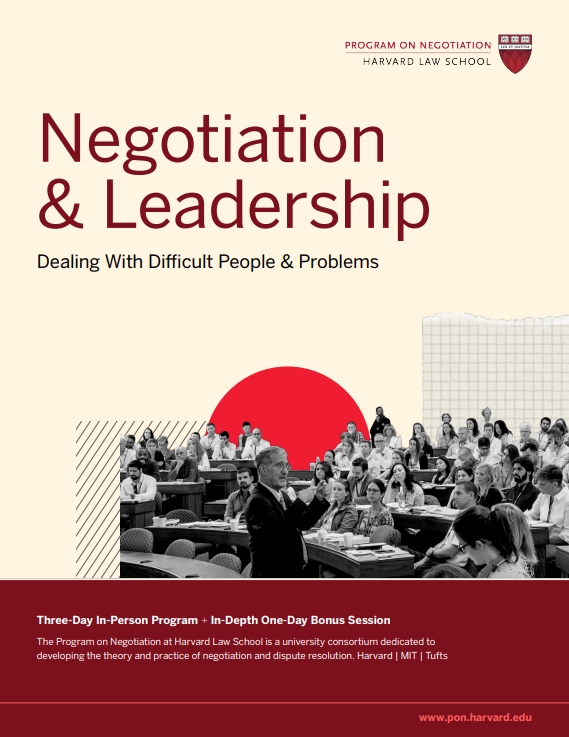
Test your beliefs and assumptions, overcome emotional and rational biases, examine complex negotiation scenarios, and discover a range of competitive and cooperative negotiation strategies. In this acclaimed program, we compress 30 years of groundbreaking research into six thought-provoking sessions. In sessions taught by our expert faculty, you’ll broaden your understanding of negotiating concepts, acquire proven negotiating techniques, and have the opportunity to put your learning into practice. … LEARN MORE ABOUT THIS PROGRAM
IN-PERSON
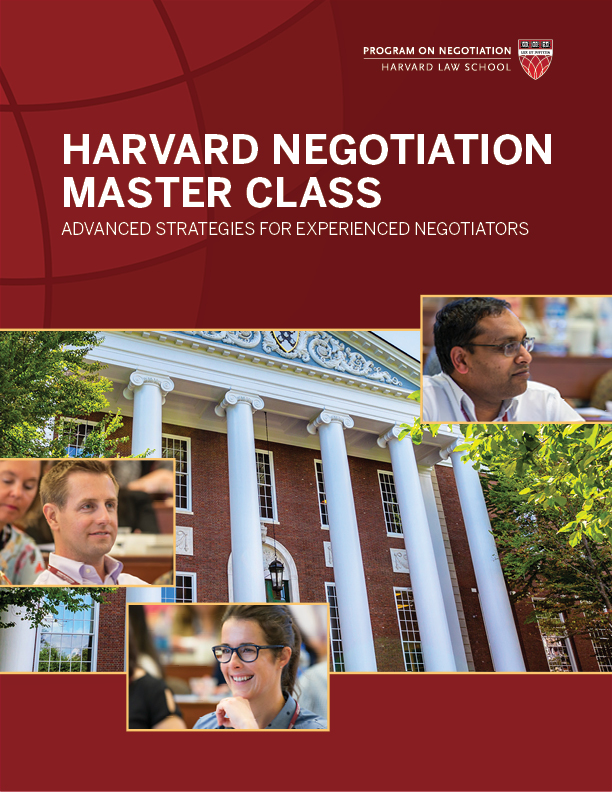
The Program on Negotiation is offering a master-level course for experienced negotiators. The program is taught by seven negotiation experts from Harvard Law School, Harvard Business School, Harvard Kennedy School, Harvard Graduate School of Education, and the Massachusetts Institute of Technology. If you are selected to participate, you will take part in dynamic exercises with two-way feedback and participate in intensive simulations.
Register Online:
December 2026
April 2027
…
LEARN MORE ABOUT THIS PROGRAM
IN-PERSON
This intensive, practice-oriented Advanced Mediation Program is designed for experienced mediators seeking to deepen their expertise and expand their toolkit for handling complex, high-stakes, and cross-cultural disputes. Through a combination of interactive lectures, role plays, group exercises, and real-world case studies, participants will gain advanced techniques and strategic approaches to navigate the nuanced dynamics of modern mediation. … LEARN MORE ABOUT THIS PROGRAM
Executive Education FAQs
How do Executive Education Programs from top schools affect your career?
Executive education from top schools equips professionals with advanced, research-backed frameworks they can apply right away, plus credentials and networks that signal expertise to employers and clients. In a field like negotiation, that translates into concrete advantages: stronger agreements, faster dispute resolution, and greater confidence in high-stakes conversations across any industry or role.
How do you choose the right executive education program?
The programs worth your time share a few traits: recognized faculty, a curriculum grounded in real-world application, formats that fit a working schedule, and skills you can use immediately. Weigh the instructors’ expertise, the depth of the material, and whether the format (one-day, two-day, or semester-length) matches your goals and availability. PON programs, for example, are taught by leading Harvard faculty and built around practical negotiation and mediation skills.
Is a short executive management program worth it?
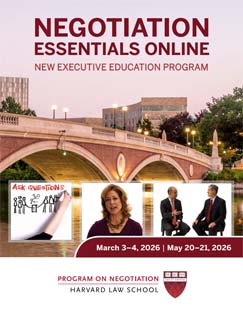
Yes, when it delivers focused, applicable skills. A one- or two-day program lets busy professionals build targeted expertise without stepping away from work for long. PON’s one-day PONx programs and two-day options like Negotiation Essentials concentrate the most useful strategies into a short window so you can apply them right away.
How can an executive education program help your career?
It sharpens specific, in-demand skills, widens your professional network, and adds a respected credential to your résumé. In negotiation and conflict management, the payoff often shows up quickly: better deals, stronger working relationships, and more leverage in difficult conversations.
What is executive education?
Executive education refers to non-degree professional development programs designed for working professionals who want to build or refresh specific skills. Courses run shorter than degree programs and focus on practical, applicable expertise, ranging from one-day sessions to semester-length seminars taught by faculty and practitioners with deep subject knowledge.
Why is executive education worth it?
Roles, markets, and best practices change, and executive education keeps your skills current and competitive without pausing your career. For anyone who negotiates, mediates, or manages conflict, structured training replaces trial and error with proven frameworks.