


In the workplace, it can sometimes feel as if certain types of conflict are simply part of the landscape. Miss a deadline, and conflict with your boss may follow. Snap at a colleague you believe is undermining you, and tensions escalate. Disagree with a fellow manager about representing a client whose values you question, and conflict is almost inevitable.
Organizational conflict isn’t unusual—but it does tend to fall into recognizable patterns.
In particular, three types of conflict commonly arise in organizations: task conflict, relationship conflict, and value conflict. While open communication, collaboration, and mutual respect go a long way toward effective conflict management, each of these three types of conflict can benefit from targeted resolution strategies.
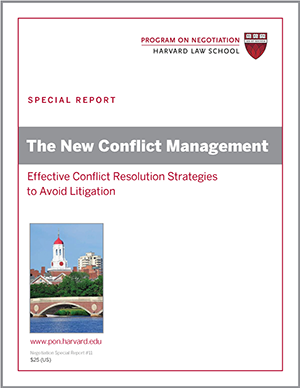
Claim your FREE copy: The New Conflict Management
In our FREE special report from the Program on Negotiation at Harvard Law School - The New Conflict Management: Effective Conflict Resolution Strategies to Avoid Litigation – renowned negotiation experts uncover unconventional approaches to conflict management that can turn adversaries into partners.
Task Conflict
The first of the three types of workplace conflict—task conflict—typically centers on concrete work issues. It can include:
- Disputes over how to allocate resources
- Differences of opinion about procedures or policies
- Clashing interpretations of data
- Misaligned expectations about roles or deadlines
Of the three types of conflict, task conflict may appear to be the most straightforward. After all, it focuses on “the work.”
Yet task conflict often has deeper roots than it initially seems. For example, coworkers arguing over who should attend an out-of-town conference may appear to be debating logistics—but underlying that dispute may be rivalry, status concerns, or perceived inequities.
Because task conflict frequently masks deeper interests, it often benefits from leadership intervention. Managers can serve as informal mediators by:
- Practicing active listening
- Asking clarifying and probing questions
- Reflecting back what they hear
- Identifying underlying interests behind stated positions
Rather than imposing a decision, leaders can guide the parties through a collaborative problem-solving process. When employees generate solutions together—brainstorming options and evaluating tradeoffs—they are more likely to commit to the outcome and preserve working relationships.
Handled constructively, task conflict can even improve decision-making by surfacing diverse perspectives and preventing groupthink.
Relationship Conflict
The second type, relationship conflict, stems from interpersonal differences. These may involve:
- Personality clashes
- Communication styles
- Differences in temperament
- Matters of taste or working style
- Divergent conflict styles
Organizations often bring together individuals who would not naturally choose to spend time together outside of work. It’s no surprise, then, that relationship conflict can arise.
If you’ve experienced lingering tension with a colleague—whether due to personality differences or past misunderstandings—consider addressing it directly before escalating it. Inviting the person to lunch or coffee and making an effort to build rapport can shift the dynamic.
Discovering common ground—shared hometowns, similar career paths, comparable family situations, or mutual concerns about organizational challenges—can humanize the interaction and reduce defensiveness.
If you feel comfortable, gently raise the source of the tension. Focus first on listening. Resist the instinct to argue your case or defend yourself. Demonstrating empathy and curiosity often invites reciprocity.
If the conflict continues or intensifies, involving a manager or neutral third party may help reset communication patterns and clarify expectations.
Value Conflict
The third category—value conflict—can be the most challenging. Value conflict arises from fundamental differences in identities and deeply held beliefs, including:
- Political views
- Religious beliefs
- Ethical principles
- Norms and cultural expectations
Although politics and religion are often considered off-limits in professional settings, value conflicts frequently surface in work-related decisions. For example:
- Whether to adopt certain diversity or inclusion policies
- Whether to represent a controversial client
- Whether to partner with organizations linked to questionable practices
According to Lawrence Susskind of Massachusetts Institute of Technology, disputes involving values tend to heighten defensiveness, distrust, and feelings of alienation. Individuals may cling tightly to their principles—even rejecting solutions that would otherwise serve their interests.
Rather than attempting to “win” a values-based dispute, Susskind suggests shifting the goal toward mutual understanding and respect through dialogue.
This means striving for cognitive understanding—an accurate conceptualization of the other person’s point of view—even if you do not agree with it.
As Robert Mnookin, Scott R. Peppet, and Andrew S. Tulumello explain in Beyond Winning, this “values-neutral” understanding does not require sympathy or emotional alignment. It requires only the ability to describe another person’s perspective accurately and fairly.
In some cases, reframing can also help. As Susskind notes, it may be possible to appeal to broader, shared values—such as fairness, equal treatment, or nonviolence—rather than focusing narrowly on the belief differences that triggered the dispute.
Choosing the Right Strategy
Understanding which type of conflict you are facing—task, relationship, or value—can clarify your path forward.
- Task conflict benefits from structured problem-solving and interest exploration.
- Relationship conflict responds to rapport-building and improved communication.
- Value conflict requires patience, dialogue, and a shift toward mutual understanding rather than immediate resolution.
Conflict in organizations is unavoidable. But with the right approach, it can become an opportunity—for clearer thinking, stronger relationships, and more thoughtful decision-making—rather than a source of lasting division.
Learn more about conflict and dispute resolution when you read these items:
What is Conflict Resolution, and How Does It Work?
How to manage conflict at work through conflict resolution
If you work with others, sooner or later you will almost inevitably face the need for conflict resolution. You may need to mediate a dispute between two members of your department. Or you may find yourself angered by something a colleague reportedly said about you in a meeting. Or you may need to engage in … Read What is Conflict Resolution, and How Does It Work? >>
Conflict Styles and Bargaining Styles
Our conflict and negotiation styles have a significant impact on how we manage conflict and negotiate. Two different models can help identify our tendencies and those of our counterparts.
What type of negotiator are you? Many negotiation strategies are “one size fits all,” but our unique personalities and life experiences will shape how we carry out and react to such strategies. Familiarity with different kinds of negotiation and conflict management styles can help us better understand and work with our own tendencies and … Read Conflict Styles and Bargaining Styles >>
Types of Conflict in Business Negotiation—and How to Avoid Them
The types of conflict we face in business negotiation can be categorized by our role and relationship with the other party. By preparing for characteristics of each one, we will be better positioned to avoid them in the first place.
Conflict in business negotiation is common, but it doesn’t have to be that way. There are steps we can take to avoid certain types of conflict and misunderstanding. Often, it helps to analyze the unique causes of conflict in particular negotiation situations. Here, we look at three frequent types of conflict in business negotiations and offer … Read Types of Conflict in Business Negotiation—and How to Avoid Them >>
What are the Three Basic Types of Dispute Resolution? What to Know About Mediation, Arbitration, and Litigation
How to choose the best dispute resolution process
When it comes to dispute resolution, we now have many choices. Understandably, disputants are often confused about which process to use. … Read What are the Three Basic Types of Dispute Resolution? What to Know About Mediation, Arbitration, and Litigation >>
Elements of Conflict: Diagnose What’s Gone Wrong
Basic elements of conflict contribute to disputes and cause them to escalate. We describe three primary elements of conflict and suggest ways to address them productively in your negotiations.
In the heat of conflict, it can be difficult to think rationally about how you got where you are and how you might make things better. But by taking a break to consider the elements of conflict, you can move toward a more rational assessment of the dispute and come up with ways to address … Read Elements of Conflict: Diagnose What’s Gone Wrong >>
Conflict-Management Styles: Pitfalls and Best Practices
Conflict-management styles can affect how disputes play out in organizations and beyond. Research on conflict-management styles offers advice on managing such difficult situations.
People approach conflict differently, depending on their innate tendencies, their life experiences, and the demands of the moment. Negotiation and conflict-management research reveals how our differing conflict-management styles mesh with best practices … Read Conflict-Management Styles: Pitfalls and Best Practices >>
Get Stories about Types of Conflict
Access our library of blog articles dealing with types of conflict.
From negotiation and conflict management styles to types of conflict and how to avoid them. Even more stories about learning from mediating professional sports disputes and what is an arbitration agreement to negotiating values in conflict resolution scenarios. And more … Read Stories about Types of Conflict >>
What types of conflict seem to be most prevalent in your organization? Leave us a comment.
Claim your FREE copy: The New Conflict Management
In our FREE special report from the Program on Negotiation at Harvard Law School - The New Conflict Management: Effective Conflict Resolution Strategies to Avoid Litigation – renowned negotiation experts uncover unconventional approaches to conflict management that can turn adversaries into partners.




This was a helpful article as I am researching and writing about conflict management for a leadership curriculum. I see all three is being interconnected, while yet separate. Hence, the need to cognitively separate out these different ways of thinking (of what we value) is important.
I believe task conflict is the most prevalent in our organization most times due to staffing issues. Once a task is assigned, even when the staffing has been resolved the task is not reassigned to the proper department or function.
Whether it is relationship task or value oriented, conflicts arise out of images and perceptions which one has. This is again anchored in memory and conditioning. Unless the perception changes, de_escalation is not possible. Recognition, Aknowledgment and Connect are the core. Indian philosophy talks about understanding the type of energy sustaining the conflict and then being motivated to move from entitlements to equanimity
I find that task related conflict dominates followed by relationship conflicts. Value related conflicts are very limited due the nature of the organisational set up and its value system.
Great piece of work done here which provides excellent resolutions especially to management staff on dealing with day to day issues in our organisations. The three types of conflict are visible,although the value conflict due to issues to do with religion are more .
It’s helpful to have these common conflicts categorized in this way. I wonder where identity-based and cultural disputes involving gender, sexual orientation, or ethnicity would fall under? These issues are in some cases more sensitive or personal than value and relationship conflicts but I could see them falling under either. Thanks.
Identity-based and cultural disputes involving gender, sexual orientation, or ethnicity are typically classified as value conflicts. Value conflicts arise when people disagree on what is right or wrong, good or bad, just or unjust, and so on.
These types of conflicts involve deeply held beliefs, attitudes, and values that individuals and groups attach to their identity and sense of self. As a result, they can be particularly sensitive and personal, as you noted. However, they are still ultimately conflicted about values.
That being said, it’s essential to recognise that conflicts related to gender, sexual orientation, or ethnicity can also have relationship components. For example, someone might feel that a friend or family member’s beliefs about their identity are hurtful or disrespectful, which could strain their relationship. In these cases, the conflict might involve both value and relationship components.
Overall, the classification of a conflict as value-based or relationship-based is not always clear-cut, and there can be an overlap between the two categories. It’s essential to consider the specific nature of the conflict and the context in which it occurs in order to determine the most appropriate way to address it.