If you’re wondering how to negotiate a higher salary after a job offer, congratulations: You’re aiming higher than many job candidates ever do. It’s common for prospective employees to accept whatever offer the would-be employer puts forth without negotiating for more. Unless the employer explicitly stipulates that their offers are nonnegotiable, that’s typically a mistake. In fact, because they expect job candidates to negotiate salary, employers typically offer somewhat less than they are willing to pay.
Here are some dos and don’ts from negotiation experts on how to negotiate a higher salary after a job offer.
Don’t Ask If the Offer Is Negotiable
Suppose you’ve just received a job offer. Out of politeness or uncertainty about what comes next, you might consider asking whether the offer is up for discussion. In their book, The Essentials of Job Negotiations: Proven Strategies for Getting What You Want, Terri R. Kurtzberg and Charles E. Naquin advise against this: “Don’t ask if an offer is negotiable; just jump right in and put your requests on the table.” Go ahead and make a counteroffer without asking permission, or you’ll risk ending the conversation before it has a chance to start. Anchoring the conversation on the assumption that the organization’s offer is the opening round rather than the final say could lead your counterpart to be more flexible than they had planned to be.
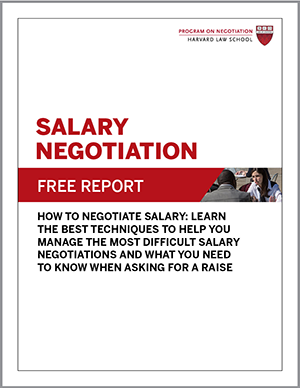
Claim your FREE copy: Salary Negotiations
Discover how to refine your negotiation skills with this free special report, Salary Negotiations: How to Negotiate Salary: Learn the Best Techniques to Help You Manage the Most Difficult Salary Negotiations and What You Need to Know When Asking for a Raise, from Harvard Law School.
Do Prepare to Negotiate More Than Just Salary
In most negotiations, haggling over a single issue, such as salary, is a mistake. Discussing multiple issues opens up many more opportunities to create new sources of value by making tradeoffs across issues. So, rather than zeroing in on salary, take time to think about the range of issues at stake, including benefits, role, and location. If a hiring manager says they don’t have much wiggle room on salary, for example, maybe you can make comparable financial gains by negotiating for tuition or training benefits. Conversely, if your target salary would be high for your position, you may need to prepare to make a concession on another issue, such as the amount of time you will spend traveling for work.
Don’t Get in Your Own Way
In job negotiations, including salary negotiations, we often “get in our own way,” write Simmons School of Management professor emerita Deborah M. Kolb and Jessica L. Porter in their book Negotiating at Work: Turn Small Wins Into Big Gains. Self-doubt about our value, as well as the common (and often false) belief that the hiring organization has all the power in the job negotiation, can hold us back when we are considering how to negotiate a higher salary after a job offer. Recognize that your negative thoughts could be incorrect and self-defeating—and consider why you might deserve to earn more than you think you do.
Do Thoroughly Research What You’re Worth
Preparation for negotiation is always important, and it’s downright crucial when negotiating a higher salary. “Setting the right target, in other words, a target that’s high but fair, ambitious but appropriate, well founded but also realistic, requires research,” write Linda Babcock and Sara Laschever in their book Ask for It. Fortunately, there is likely to be ample information online about salary ranges for particular jobs in your area, perhaps even for the very job you’re considering. You might also reach out to others in your field to find out what a reasonable counteroffer might be. And if you are fortunate to have one or more competing offers from other organizations, they can provide strong benchmarks as well.
Don’t Forget to Justify Your Offer
Whatever counteroffer you make, it should “come coupled with persuasive logic that feels fair and reasonable to the other side,” write Kurtzberg and Naquin. It is critical that both sides feel the other side has been fair, they explain. During the salary negotiation process, be sure to present the research you’ve done, such as industry benchmarks, as well as any attractive competing offers you may be considering. It’s also smart to justify your request based on any unique skills or experience you possess relative to other candidates for the job.
Do Take a Long-Term View
When considering how to negotiate a higher salary after a job offer, remember that your negotiation is just the first stage in what might become a long-term business relationship. Job negotiations provide a chance to show off your negotiating ability, your collegiality, and your reasonableness. So, avoid hardball tactics, such as threatening to walk away if you don’t get your desired salary, insisting on concessions just for the sake of “winning,” or acting offended by a low opening offer. Most hiring negotiators will see through such strategies and may even consider withdrawing their offer if you use them.
What other advice do you have on how to negotiate a higher salary after a job offer?