


People approach conflict differently. Our responses are shaped by personality, life experience, organizational culture, and the pressures of the moment.
Research in negotiation and conflict management shows that these differing conflict-management styles don’t just shape outcomes—they influence whether relationships strengthen or fracture over time.
If you’ve ever wondered “What is my conflict style?” or “Which conflict-management style works best in negotiation?”—you’re not alone. Understanding these patterns can dramatically improve how you handle workplace disagreements, business negotiations, and even personal conflicts.
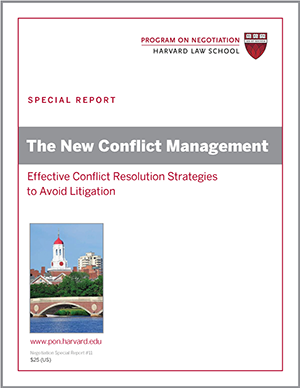
Claim your FREE copy: The New Conflict Management
In our FREE special report from the Program on Negotiation at Harvard Law School - The New Conflict Management: Effective Conflict Resolution Strategies to Avoid Litigation – renowned negotiation experts uncover unconventional approaches to conflict management that can turn adversaries into partners.
A Model of Conflict-Management Styles
In 1974, Kenneth W. Thomas and Ralph H. Kilmann introduced the Thomas-Kilmann Conflict Mode Instrument (TKI), a widely used assessment tool designed to measure individuals’ approaches to conflict.
Based on responses to paired statements, the instrument identifies five primary conflict-management styles:
- Competing (Win-Lose Orientation)
When adopting a competing style, people treat conflict as a win-lose contest. The focus is on asserting one’s position and claiming as much value as possible.
Value claiming is, of course, an important part of negotiation. But when competition becomes the only strategy, it can:
- Damage long-term relationships
- Sacrifice opportunities for joint gains
- Escalate tensions unnecessarily
A purely competitive orientation often wins the battle while losing the relationship.
- Avoiding (Conflict Withdrawal)
Conflict can be uncomfortable. For many, the instinct is to sidestep it altogether.
Avoidance may appear to be the opposite of competition, but it can be just as counterproductive. When we avoid difficult conversations:
- Problems tend to grow larger
- Misunderstandings harden into resentment
- Important decisions get delayed
That said, strategic avoidance can sometimes be wise—particularly when emotions are running high or when the issue is trivial.
- Accommodating (Yielding to Preserve Harmony)
Accommodators defer to others and prioritize preserving relationships over asserting their own needs.
This style can make someone appear agreeable and easygoing. But consistent self-sacrifice can lead to:
- Burnout
- Hidden resentment
- Unequal power dynamics
Negotiators who lean toward accommodation often benefit from learning how to articulate their interests clearly and confidently.
- Compromising (Meeting in the Middle)
Compromising involves finding middle ground—splitting differences or trading concessions to move forward.
This approach can resolve disputes quickly. However, it often produces:
- Temporary solutions
- Outcomes that satisfy no one fully
- Agreements that ignore deeper interests
Compromise can be practical—but it is not the same as true collaboration.
- Collaborating (Win-Win Problem Solving)
Collaborators dig beneath surface positions to uncover underlying interests. They are willing to:
- Explore tradeoffs across multiple issues
- Express their own needs directly
- Work through strong emotions
- Search for creative, mutually beneficial solutions
Among conflict-management styles, collaboration is generally the most effective for building sustainable agreements and productive long-term relationships.
Is One Conflict Style Best?
A collaborative negotiation style is often ideal—but no single style works in every situation.
Even if we have a preferred style, most of us shift approaches depending on context.
For example:
- Competing may be appropriate after joint value creation, when dividing limited resources.
- Accommodating may be prudent when a supervisor is upset and immediate de-escalation is necessary.
- Avoiding can be wise when dealing with a volatile individual.
- Compromising may efficiently resolve minor issues.
The key isn’t rigid adherence to one style—it’s strategic flexibility.
Conflict-Management Styles: Lessons from Marriage Research
Can people with different conflict styles thrive together?
In Why Marriages Succeed or Fail . . . and How You Can Make Yours Last (1995), psychologist John Gottman identified three stable problem-solving styles among successful couples:
- Validating (frequent compromise and mutual problem-solving)
- Conflict-avoidant (agreeing to disagree)
- Volatile (frequent passionate disagreements)
Surprisingly, Gottman found that all three styles can support lasting marriages. The critical factor isn’t which style couples use—it’s whether partners share the same style.
Though his research focused on marriages, the lesson applies in business: when colleagues share compatible conflict approaches, they often experience smoother interactions—even if their style isn’t especially collaborative.
When Complementary Conflict Styles Work
Interestingly, negotiation research suggests that similarity is not always best.
A 2015 study published in Negotiation and Conflict Management Research by Scott Wiltermuth, Larissa Z. Tiedens, and Margaret Neale examined how dominant and submissive negotiation styles interact.
Participants were assigned to behave either:
- Dominantly (assertive, confident, influence-oriented), or
- Submissively (cooperative, agreeable, question-asking)
Pairs composed of one dominant and one submissive negotiator outperformed pairs with matching styles.
Why?
Because complementary styles created a productive dynamic:
- The dominant negotiator clearly stated preferences.
- The submissive negotiator asked clarifying questions.
- Together, they uncovered opportunities for value creation.
The interaction allowed one party to feel heard and competent while the other gathered critical information. The result: more value claimed and more value created.
What This Means for Negotiators and Leaders
The research on conflict-management styles suggests several practical lessons:
- There is no universally “right” conflict style.
- Flexibility is more valuable than rigidity.
- Complementary approaches can unlock unexpected advantages.
- Open collaboration that addresses underlying interests remains the most reliable path to durable agreements.
Rather than spending excessive time labeling yourself—or diagnosing others—focus on building skills that support:
- Emotional regulation
- Active listening
- Clear interest articulation
- Creative problem solving
Conflict is not inherently destructive. Managed thoughtfully, it becomes a powerful engine for better decisions and stronger relationships.
What Have You Learned?
What lessons about conflict-management styles have you learned in your own negotiation or conflict-resolution experiences? When have differences strengthened—or strained—your negotiations?
Claim your FREE copy: The New Conflict Management
In our FREE special report from the Program on Negotiation at Harvard Law School - The New Conflict Management: Effective Conflict Resolution Strategies to Avoid Litigation – renowned negotiation experts uncover unconventional approaches to conflict management that can turn adversaries into partners.




I enjoyed reading this article and agree with the conclusion that effective conflict management requires adapting one’s style based on context. The research cited—from the stable styles in marriage to the benefits of complementary behaviors in negotiation—reinforces the idea that rigidity is counterproductive.
I believe a lack of self awareness and not understanding others communication styles is detrimental to successfully navigating conflict. There are many tools and frameworks available to improve conflict management skills and from personal experience with taking the Everything DiSC Productive Conflict assessment, valuable insights and strategies were takeaways for me to navigate conflict in high pressure situations.