


What is the winner’s curse? Imagine that at the beginning of class, a professor produces a jar full of coins and announces that he is auctioning it off (for more on the winner’s curse see also, A Win Without Regrets – Winning an Auction and Not Feeling Disappointed). Students can write down a bid, he explains, and the highest bidder wins the contents of the jar in exchange for his or her bid.
After everyone has written down their bids, the professor polls the class to find out how they bid. Bob turns out to be the high bidder, at $45.
“Congratulations, Bob, you’ve just won all the coins in the jar!” the professor says. “How do you feel?”
“Lousy,” says Bob, before even hearing how much money the jar contains.
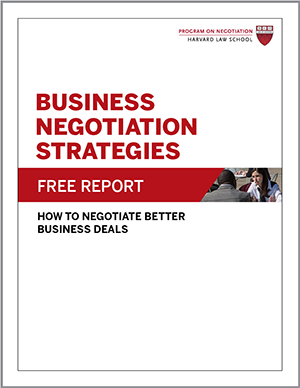
Claim your FREE copy: Business Negotiation Strategies: How to Negotiate Better Business Deals
Discover step-by-step techniques for avoiding common business negotiation pitfalls when you download a copy of the FREE special report, Business Negotiation Strategies: How to Negotiate Better Business Deals, from the Program on Negotiation at Harvard Law School.
Winner’s Curse: Negotiation Scenarios in Competitive Bidding
This simple game is a classic illustration of the winner’s curse phenomenon in competitive bidding. The winner’s curse describes a common problem in negotiation: lacking an advanced understanding of this phenomenon, the party who wins an auction of a commodity of uncertain value with a fair number of bidders typically pays more than the asset is actually worth.
Auctions pervade our world, from mergers-and-acquisitions deals and procurement auctions to eBay. To avoid becoming the next victim of the winner’s curse, follow these three guidelines:
- Analyze whether the asset has a common value element. A common value asset, like a jar of coins, has equal value to all bidders. If so, bid with caution.
- Assess your capabilities and compare them with those of other bidders.
- Before placing each bid, pause to consider how you would feel if you won the auction.
Too many winners of auctions end up feeling cursed by their victories. And Bob was correct in feeling lousy. The jar he won contained about $20 in coins. Remember in your next competitive bidding negotiation scenario that winning isn’t always the most optimal, or value-creating option on the negotiation table. Evaluate your BATNA in a competitive bidding negotiation just as you would in a regular bargaining scenario – if your best alternative to winning the auction is to not win the auction, then tailor your bidding accordingly to head off the “need to succeed” at all costs.
Have you ever fell victim to the winner’s curse? Share your story in the comments.
Related Business Negotiations Article: A Win Without Regrets: Winning an Auction and Not Feeling Disappointed
Related Dealmaking Article: The Winner’s Curse
Claim your FREE copy: Business Negotiation Strategies: How to Negotiate Better Business Deals
Discover step-by-step techniques for avoiding common business negotiation pitfalls when you download a copy of the FREE special report, Business Negotiation Strategies: How to Negotiate Better Business Deals, from the Program on Negotiation at Harvard Law School.
Originally published in 2008.





No Responses to “Winner’s Curse: Negotiation Mistakes to Avoid”