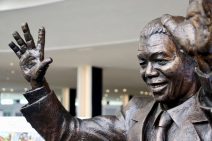
Some people learn to negotiate on the job, in a classroom, or in a therapist’s office. In Nelson Mandela’s case, “prison taught him to be a master negotiator,” writes Bill Keller in his New York Times obituary of the legendary activist turned president, who died on December 5, 2013.
Soon after his arrival at South Africa’s brutal Robben Island prison for a life sentence, Nelson Mandela “assumed a kind of command,” Keller writes. He befriended many of his white captors, introducing each one to visitors as “my guard of honor.” He tried to persuade younger political inmates to analyze their opponents’ strengths rather than plunging headlong into conflict. And during his 27 years of imprisonment, Mandela deeply absorbed the value of patience, discipline, and empathy.
Nelson Mandela may have honed many of the skills he used in government negotiations in prison, but he was a natural-born dealmaker. Those of us in less-challenging realms than apartheid-era South Africa can learn from his beliefs, decisions, and actions.
Claim your FREE copy: Real Leaders Negotiate
If you aspire to be a great leader, not just a boss, start here: Download our FREE Special Report, Real Leaders Negotiate: Understanding the Difference between Leadership and Management, from Harvard Law School.
A Hard-line Position
In the late 1940s, Nelson Mandela became active in the African National Congress (ANC), a well-established South African political organization dedicated to securing full citizenship for Blacks. As he rose through the ranks and gained influence, Mandela began to question the ANC’s reliance on peaceful protest to make headway. Without vetting his views with ANC leadership, he publicly spoke out in favor of armed resistance, only to be censured for diverging with the organization’s policy.
Decades later, Mandela took a similar approach when making a much more fateful break with the ANC’s party line. In 1985, 23 years into his imprisonment, numerous signs—including international pressure, a devastating trade boycott, and growing violence between protestors and the police—indicated that the apartheid regime was weakening.
As a result of the long hours he spent in childhood listening to the consensus-building conversations of the tribal council, Mandela observed in his autobiography, Long Walk to Freedom (Back Bay Books, 1995), that the chief “stays behind the flock, letting the most nimble go ahead, whereupon the others follow, not realizing they are being led from behind.”
The ANC held the stance that it would not negotiate with the South African government. Mandela himself had personally rejected the possibility of negotiation in numerous public statements, once saying, “Only free men can negotiate.” Meanwhile, the government also took a hard line against negotiation with the ANC, believing that to do so would signal weakness.
Both sides insisted they would not negotiate unless each made significant concessions, a “classic problem in prolonged conflicts,” writes Harvard Law School professor Robert Mnookin in his book Bargaining with the Devil: When to Negotiate, When to Fight (Simon & Schuster, 2010). When each side demands that the other relinquish significant bargaining power before talks even begin, negotiation is unlikely, and conflict calcifies.
Moving Ahead of the Flock
Given the entrenched stalemate, it was remarkable that Nelson Mandela decided to try to launch negotiations between the ANC and the government. Even more strikingly, he had no authority to speak on behalf of the ANC, which was run as a collective.
Believing that his fellow ANC leaders would disagree with his decision, Mandela covertly sent a letter to South Africa’s minister of justice, Kobie Coetsee, in which he offered to meet secretly to discuss the possibility of negotiations. Coetsee eventually agreed, and the two men launched clandestine talks that laid the groundwork for a democratic, post-apartheid South Africa.
“There are times when a leader must move out ahead of the flock and go off in a new direction, confident that he is leading people the right way,” Mandela wrote of his bold decision in Long Walk to Freedom.
For most of us, secretly moving forward with a negotiation against the wishes of our superiors and colleagues would be a risky, even foolish move. Business negotiators typically must secure buy-in from others in their organization before breaking from past practice. For such contexts, Mandela, who was raised by a prominent tribal chief, offers another useful shepherding metaphor. As a result of the long hours he spent in childhood listening to the consensus-building conversations of the tribal council, Mandela observed in his autobiography, Long Walk to Freedom (Back Bay Books, 1995), that the chief “stays behind the flock, letting the most nimble go ahead, whereupon the others follow, not realizing they are being led from behind.”
The quote suggests the value of lobbying others in support of your cause, then letting them make your argument to reluctant parties. This is the type of “mapping backward” strategy that David A. Lax and James K. Sebenius elaborate on in their book 3-D Negotiation: Powerful Tools to Change the Game in Your Most Important Deals (Harvard Business School Publishing, 2006). More broadly, Mandela’s stealth overtures remind us that those who see clearly what others cannot may have a responsibility to use their powers of persuasion to win over naysayers—and to act without them when necessary.
Claim your FREE copy: Real Leaders Negotiate
If you aspire to be a great leader, not just a boss, start here: Download our FREE Special Report, Real Leaders Negotiate: Understanding the Difference between Leadership and Management, from Harvard Law School.
“Hating Clouds the Mind”
One noteworthy quality of Nelson Mandela’s was his ability to negotiate calmly with his enemies at the same time that he was absorbed in a passionate, all-consuming struggle against them.
Asked by Keller in 2007 to explain how he kept his hatred of the regime that had oppressed him and his people in check, Mandela replied, “Hating clouds the mind. It gets in the way of strategy. Leaders cannot afford to hate.”
Even as Mandela largely succeeded in regulating his own emotions, his keen sense of empathy enabled him to identify ways to capitalize on the emotions of his counterparts and adversaries.
To take one example, after being elected president of South Africa in 1994, Mandela faced the task of ending violent conflict in the country’s large Zulu nation between the ANC and the Inkatha Freedom Party, led by Mangosuthu Buthelezi. Unlike other ANC members, who demonized Buthelezi, Mandela welcomed him into his new government, a decision that helped end the violence, writes Keller in the Times.
In an interview, Mandela explained that his peace-building efforts in the Zulu nation were based on a simple insight: Buthelezi, though raised as a member of the Zulu family, was tortured by the fact that he was a nephew rather than a direct successor to the king. By choosing “to love him into acquiescence,” writes Keller, Mandela assuaged Buthelezi’s deep-seated insecurities and won his trust and cooperation in the process.
Emotional intelligence is a valuable skill for negotiators, allowing us to accurately read our counterparts’ emotions, manage our own feelings, and successfully mediate conflict. To cultivate these types of negotiation skills, spend time listening to and observing your fellow negotiators, making note of their insecurities and grievances. Doing so should enable you to address their core concerns, which could have the effect of softening their position on the issues that matter most to you.
Action Over Ideology
As illustrated by his eventual willingness to negotiate with the apartheid government, Nelson Mandela was at heart a pragmatist rather than an ideologue.
“He was not a theoretician, but he was a doer,” a long time colleague of Mandela’s, Joe Matthews, said of him in an interview with the television show Frontline. “He was a man who did things, and he was always ready to volunteer to be the first to do any dangerous or difficult thing.”
This tendency toward action led Mandela to contradict himself at times, as when he steered the ANC away from nonviolence in favor of armed insurrection in the wake of a police massacre of peaceful demonstrators in 1961. He explained later that his nonviolence rhetoric had been “not a moral principle but a strategy; there is no moral goodness in using an ineffective weapon.”
Mandela’s decision to initiate negotiations with the South African government from prison may serve as the most prominent example of his willingness to change his positions in the service of his greater goals. As Mnookin explains in Bargaining with the Devil, negotiators sometimes face the difficult decision of whether to engage with a person or organization they consider to be morally repugnant. Typically, we choose not to negotiate in such situations, or we allow a dispute to escalate into litigation. Demonizing the other side, we believe we will be tainted by association or that the other party will inevitably take advantage of us.
Not negotiating with an enemy on moral grounds can be a legitimate decision. But because our moral judgments tend to be based on intuition, not reason, they can be dangerous traps. When we take a hard-line stance without thoroughly analyzing the likely costs and benefits of negotiating, we risk allowing our principles to get in the way of the greater good. Wise negotiators follow Mandela’s example and rationally consider whether or not to negotiate.
Which negotiation skills and strategies of Nelson Mandela would you like to apply to your own negotiations?