


All too often, when two people or organizations try to settle a dispute by arguing over who is right, they reach an impasse. This focus on winning rather than understanding is one reason so many conflicts ultimately end up in court. A more effective path is mediation, guided by an expert mediator who helps both sides look beyond rigid positions to uncover their underlying interests—the needs, desires, and concerns that truly drive the disagreement. When someone asks why a dispute matters to you, your answer reveals far more than your stance on the issue—it uncovers the interests at the heart of the conflict, and that’s where genuine resolution begins.
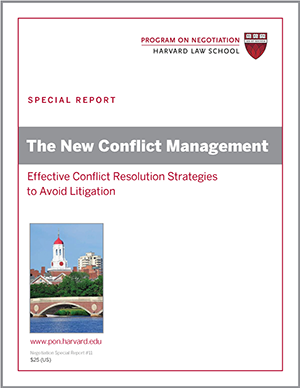
Claim your FREE copy: The New Conflict Management
In our FREE special report from the Program on Negotiation at Harvard Law School - The New Conflict Management: Effective Conflict Resolution Strategies to Avoid Litigation – renowned negotiation experts uncover unconventional approaches to conflict management that can turn adversaries into partners.
The Conflict Resolution Process: Resolving Workplace Disputes
As a simple illustration, imagine that two administrative assistants with adjoining desks disagree about whether the window behind them should be open or closed. One claims that she has the right to decide because she has seniority, while the other insists he should get his way because he conceded to the senior colleague in a disagreement about lighting. The office manager asks both to explain their preferences. The senior employee says that the draft from the open window gives her a stiff neck.
Her colleague says that without fresh air, he gets sleepy. Suddenly, an agreement is easy: the office manager opens a window in the adjoining storeroom, and the two assistants have fresh air with no draft. Acting as an interest-based mediator, the office manager probed for the interests underlying the assistants’ positions. When the positions of disputing parties cannot be reconciled, a focus on interests often will lead to a mutually satisfactory outcome.
But can a focus on interests be applied to complex business disputes? (See also, Negotiation Research on Mediation Techniques: Focus on Interests).
Yes.
In fact, a mediator who initially knows little or nothing about the underlying technical issues often can resolve the most complex disputes. (See also, Integrative Negotiation Examples and Noncompete Agreements: Negotiating Skills and Negotiation Techniques for Conflict Resolution).
Why?
In the first place, a good interest-based mediator will be a fast learner, capable of quickly picking up the technical knowledge necessary to discuss the problem. More important, an interest-based mediator doesn’t need to fully understand the technical aspects of a problem to assess why the dispute is important to each party and which solutions each party might accept. By beginning with this knowledge and eventually exchanging settlement proposals, the interest-based mediator can help parties resolve the most complex technical problems.
Leave a comment: When do YOU use mediation vs. arbitration?
Related Conflict Resolution Article: Top 10 Conflict Resolution Articles
Claim your FREE copy: The New Conflict Management
In our FREE special report from the Program on Negotiation at Harvard Law School - The New Conflict Management: Effective Conflict Resolution Strategies to Avoid Litigation – renowned negotiation experts uncover unconventional approaches to conflict management that can turn adversaries into partners.
Adapted from “Beyond Blame: Choosing a Mediator,” by Stephen B. Goldberg (professor, Northwestern University), first published in the Negotiation newsletter, January 2006.
Originally published November 2011.


Using the Arbitration and mediation process needs to be looked into with the situation and perspective in mind. Parties to the dispute need to agree on the process . If they feel that mediation is a cost effective way and offers speedy resolution , they opt for mediation.
Mediation and Conflict Resolution runs in the spring. However, Negotiation and Conflict resolution is accepting registrants for its fall semester course and it is running online.