


Conflict in work teams is common. Team members may disagree about who carried the heaviest workload—or who deserves the most credit. Those lower in the hierarchy may feel overlooked or marginalized and become resentful or disengaged. And collaborators frequently clash over which ideas deserve priority and how projects should move forward.
So how should teams handle these conflicts?
Many conflict resolution experts focus on reducing or eliminating conflict wherever possible. But mediator Howard Gadlin came to a different conclusion after years working as an ombudsperson at organizations including the U.S. National Institutes of Health, UCLA, and Harvard University.
Gadlin realized something surprising: in many high-performing teams, the goal isn’t to eliminate conflict—it’s to make disagreement productive.
As he writes in The Negotiator’s Desk Reference, science itself depends on disagreement. The real task, he found, was creating conditions for productive conflict rather than trying to eliminate differences altogether.
And that lesson applies far beyond research labs.
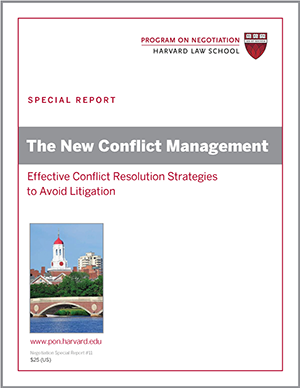
Claim your FREE copy: The New Conflict Management
In our FREE special report from the Program on Negotiation at Harvard Law School - The New Conflict Management: Effective Conflict Resolution Strategies to Avoid Litigation – renowned negotiation experts uncover unconventional approaches to conflict management that can turn adversaries into partners.
When Collaboration Breaks Down
Traditional workplace conflict resolution often focuses on helping disputing parties move from win-lose arguments toward joint problem solving.
But many professional teams already begin with a shared goal. Scientists racing to develop vaccines, researchers testing new theories, or cross-functional business teams launching products all start as collaborators—not adversaries.
Their differences in expertise and perspective are assets, not obstacles.
Yet collaboration can still break down when relationship tensions arise.
A famous example comes from psychologists Amos Tversky and Daniel Kahneman, whose partnership transformed our understanding of decision-making. As Michael Lewis recounts in The Undoing Project: A Friendship That Changed Our Minds, their debates were intense but joyful, full of intellectual friction and laughter.
Over time, however, public recognition increasingly focused on Tversky, and resentment grew. Their partnership eventually dissolved, though they reconciled before Tversky’s death in 1996.
Their story shows both the creative power of disagreement and the personal challenges collaborations face over time.
Shifting the Goal: From Ending Conflict to Improving It
Early in his mediation career, Gadlin focused on solving disputes directly. But working with scientific teams shifted his attention.
Instead of asking, How do we resolve this conflict? he began asking:
- Are people actually having the same conversation?
- Do collaborators understand each other’s perspectives and methods?
- Are disagreements about substance or miscommunication?
In many cases, teams didn’t need resolution—they needed better ways to manage ongoing differences.
The key became helping collaborators communicate clearly across differences in discipline, methods, or priorities so disagreement could fuel progress rather than stall it.
Why Conflict Feels Personal
Classic negotiation advice from Getting to Yes: Negotiating Agreement Without Giving In urges negotiators to “separate the people from the problem.” In theory, teams should tackle interpersonal tensions separately from substantive disagreements.
But in long-term collaborations, Gadlin notes, this separation is difficult.
People become deeply attached to their ideas and professional approaches. When those ideas are challenged, it can feel like a personal attack. At the same time, spirited debate can also be energizing and intellectually rewarding.
Conflict, then, is both emotional and productive.
The challenge is not eliminating emotion but ensuring it doesn’t damage working relationships.
Trust Makes Productive Conflict Possible
So how can teams handle conflict constructively?
According to Gadlin, trust is the foundation.
When trust is present, team members feel safe:
- Disagreeing openly
- Expressing frustration
- Working through hurt feelings
- Challenging ideas without attacking people
Over time, teams begin to see disagreement not as a threat but as a strength.
Simple trust-building practices help, including informal conversations and shared experiences unrelated to the immediate work. These small investments build resilience when tensions rise later.
Practical Ways to Encourage Productive Team Conflict
Teams seeking healthier collaboration can try several approaches:
- Clarify goals so disagreements focus on solutions, not status
- Encourage respectful challenges to ideas, not individuals
- Create regular forums for airing concerns before resentment grows
- Rotate leadership roles so all voices are heard
- Invest in relationship-building outside formal meetings
Conflict becomes productive when people feel heard and respected.
The Takeaway: Don’t Silence Conflict—Improve It
Conflict in teams is unavoidable. Attempting to eliminate it often suppresses useful disagreement.
Strong teams instead learn how to argue productively, challenge ideas constructively, and maintain trust even when tensions rise.
The goal is not harmony at all costs, but collaboration strong enough to survive honest disagreement.
What advice would you offer on how to handle conflict in teams? Share your experiences in the comments.
Claim your FREE copy: The New Conflict Management
In our FREE special report from the Program on Negotiation at Harvard Law School - The New Conflict Management: Effective Conflict Resolution Strategies to Avoid Litigation – renowned negotiation experts uncover unconventional approaches to conflict management that can turn adversaries into partners.




Disputes are a process that even devoted married couples experience, so understandably disputes will occur and it is reasonable that all recognise this fact.
Developing dispute resolution value could be gained from considering the root causes where a damaging dispute has a negative effect. Essential factors as to how disputes arise need to be isolated and managed and the arbitrator needs to ensure avoid any favouritism. Outlining typical difficulties as to why disputes cannot be settled naturally without damage would be of benefit to all before seeking a resolution might help all antagonists to consider their role actions and responses as well as the level of integrity they all have demonstrated in contributing to the dispute. Everything must be focussed on building a team that is able to achieve the targets aimed for. Potential factors that contribute to disputes include personal technical pride, self-esteem, patience and forgiveness with others and self-realisation of personal faults..