


When involved in a crisis negotiation, hostage negotiators stress the importance of discussing the “drill”—team goals, ground rules, and operating principles—before beginning talks with a hostage taker.
Such negotiation teams are likely to commit to working together as slowly as needed to resolve a standoff safely. This type of agreement helps head off sudden or uncoordinated actions from team members that could escalate an already tense situation.
In our article, Team Building: The Importance of Staying on Message, we discuss the preparations teams undertake when gearing up for critical negotiations. These preparations include appointing a negotiation leader, allocating negotiating roles and responsibilities, and developing the negotiation strategies and techniques to be used at the bargaining table. Just as important, teams should commit to staying “on message” throughout negotiation scenarios so that communication remains clear and consistent.
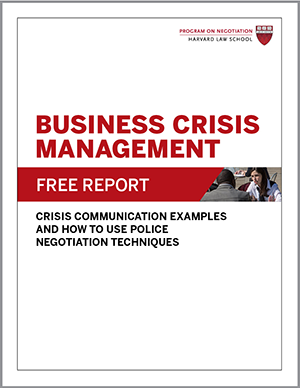
Claim your FREE copy: Business Crisis Management
Crisis negotiation skills can make or break a negotiator in heated conflicts. Learn these skills from the experts at Harvard Law School when you download our FREE Special Report, Business Crisis Management: Crisis Communication Examples and How to Use Police Negotiation Techniques
Staying aligned also helps the group present a united front if outsiders—such as police chiefs, political leaders, or other stakeholders—grow impatient and try to speed up the process. In other words, negotiating teams must ensure that individual members do not contradict group consensus during talks. One real-life example cited in Team Building: The Importance of Staying on Message is U.S. President Barack Obama’s reelection campaign, which worked to keep its media team firmly “on message” during the contest with Republican challenger Mitt Romney.
When organizing your own negotiation team, take time at the outset to discuss ground rules and shared objectives. These early conversations often save time later by promoting unity, clarity, and efficiency during negotiations.
In our article, Hostage Negotiation Tips for Business Negotiators, we outline negotiation skills and tactics crisis negotiation teams use both before and during talks. Similarly, Police Negotiation Techniques from the NYPD Crisis Negotiations Team explores how the negotiating skills used by the New York City Police Hostage Negotiations unit reflect integrative negotiation strategies designed to build cooperation and achieve sustainable outcomes.
What crisis negotiation skills would you like to add to your own arsenal of negotiation tools?
Claim your FREE copy: Business Crisis Management
Crisis negotiation skills can make or break a negotiator in heated conflicts. Learn these skills from the experts at Harvard Law School when you download our FREE Special Report, Business Crisis Management: Crisis Communication Examples and How to Use Police Negotiation Techniques
Related Dispute Resolution Article: Negotiation Examples: Repairing Relationships Using Negotiation Skills – Mending fences with a loved one or resolving a business dispute with a client are just two of the negotiation scenarios many bargainers will find themselves facing in both their careers and in their personal lives. How can negotiating skills and negotiation tactics help people resolve disputes, manage conflict, and repair relationships? Integrative negotiation strategies emphasize a win-win negotiation approach to bargaining with a counterpart, and it is this very mindset that a person needs when attempting to reconcile differences and repair relationships. Here are some successful negotiation examples using dispute resolution techniques for repairing interpersonal relationships drawn from negotiation case studies as well as some negotiating skills and negotiation techniques that bargainers can apply to a variety of negotiation scenarios from commercial negotiations and salary negotiations to interpersonal negotiations with family and friends.
Examples of Negotiation in Business: Business Negotiators Find the Right Fit – Examples of negotiation in business – a partnership too good to be true? How do you know your counterpart is the right fit for your business needs? Sometimes even the most well-bargained agreements fall flat in implementation due to differences in personality between negotiators. What factors should impact a negotiator’s decision to embark upon negotiations in the first place and how then should a negotiator proceed with her counterpart? Finding the perfect agreement and the perfect counterpart with whom to build a bargaining relationship is impossible but the two can be reconciled prior to bargaining if a negotiator understands exactly what she needs out of both a negotiated agreement and a potential business partner.
Originally published in 2009.
Claim your FREE copy: Business Crisis Management
Crisis negotiation skills can make or break a negotiator in heated conflicts. Learn these skills from the experts at Harvard Law School when you download our FREE Special Report, Business Crisis Management: Crisis Communication Examples and How to Use Police Negotiation Techniques




I would like to do the hostage negotiation course you offer. And what is the cost and duration of the course and requirements.
https://www.pon.harvard.edu/courses-and-training/3-day/special-three-day-combined-program/
I have included the link above for the programs we offer. We do not offer a specific course in hostage negotiation.