


Whether a conflict erupts at work or at home, many of us instinctively try to correct the other person’s thinking. We lecture, argue, and explain why we’re right—and they’re wrong.
Deep down, we know this conflict resolution approach rarely works. In fact, it often makes disagreements worse.
So what does work?
Research in negotiation and conflict management shows that the most effective solutions don’t come from winning arguments. They come from understanding perceptions, managing emotions, and uncovering interests beneath the surface.
Below are five conflict resolution strategies drawn from negotiation research that you can use the next time you feel tempted to argue your point.
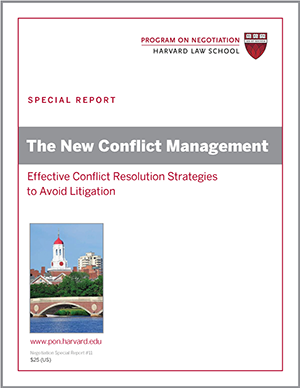
Claim your FREE copy: The New Conflict Management
In our FREE special report from the Program on Negotiation at Harvard Law School - The New Conflict Management: Effective Conflict Resolution Strategies to Avoid Litigation – renowned negotiation experts uncover unconventional approaches to conflict management that can turn adversaries into partners.
- Conflict Resolution Strategy #1: Recognize That Fairness Looks Different to Everyone
In most conflicts, both parties believe they are right. This isn’t stubbornness—it’s psychology.Research by Carnegie Mellon professors Linda Babcock and George Loewenstein and colleagues shows that our sense of fairness is heavily shaped by egocentrism, meaning we struggle to fully see situations from another person’s perspective.
When conflict heats up, try to step outside your own viewpoint.
Helpful options include:- Hiring a mediator or neutral facilitator
- Asking an unbiased expert to weigh in on disputed facts
- Jointly reviewing objective standards or data
- Actively asking the other person how they see the situation
Even a small shift in perspective can open the door to resolution.
- Conflict Resolution Strategy #2: Avoid Threats and Escalation
When we feel ignored or steamrolled, we often resort to threats:- “I’ll take this to court.”
- “I’ll escalate this to management.”
- “I’ll make this public.”
While legal or formal action is sometimes necessary, threats often backfire.
Human beings tend to mirror behavior. Threats invite counter-threats, leading to escalation and damaged relationships. Take-it-or-leave-it offers and public pressure campaigns often lock both sides into defensive positions.
Before issuing threats, ask:
- Have we explored all problem-solving options?
- Have both sides truly been heard?
- Is escalation likely to solve or worsen the situation?
Keeping discussions collaborative preserves room for resolution.
- Conflict Resolution Strategy #3: Break Out of “Us vs. Them” Thinking
Group identity is powerful. It builds loyalty—but it can also fuel conflict.In disputes, we often see our own side as reasonable and the other side as extreme or unreasonable. In reality, both sides frequently misunderstand each other’s positions.
To shift dynamics:
- Highlight shared goals early in discussions
- Identify similarities or common interests
- Emphasize mutual outcomes rather than competing wins
For example, coworkers in conflict may ultimately share the same goal: project success. Divorcing parents may both want stability for their children. Business partners usually want the company to thrive.
The more shared ground you uncover, the easier cooperation becomes.
- Conflict Resolution Strategy #4: Look Beneath the Surface
Many disputes appear to be about money, resources, or decisions.But often, something deeper is driving the conflict:
- Feeling disrespected
- Fear of being excluded or overlooked
- Lack of recognition
- Loss of trust or autonomy
When conversations stall over numbers or decisions, try pausing that discussion and asking:
- “What concerns you most about this situation?”
- “What feels unfair here?”
- “What would make this outcome feel acceptable to you?”
Listening carefully can reveal new solutions.
By addressing underlying concerns, you expand options and often strengthen relationships at the same time—creating more value to share rather than fighting over a fixed pie.
- Conflict Resolution Strategy #5: Separate Sacred from Pseudo-Sacred Issues Conflicts become especially difficult when core values appear to be at stake—family traditions, religious beliefs, moral commitments, or identity issues.
Program on Negotiation Chair Robert Mnookin notes that people often avoid negotiating in such situations. But Harvard Business School professor Max H. Bazerman observes that many supposedly sacred issues are actually pseudo-sacred—meaning they may be negotiable under certain conditions.
Consider siblings debating whether to sell a family farm. One insists the land must stay in the family; the other believes selling is financially necessary. The disagreement seems absolute—until alternatives emerge, such as preserving part of the land or donating part of the proceeds in honor of their parents.
When values are involved, ask:
- What principle truly matters here?
- Are there ways to honor that value while still moving forward?
- What outcomes would feel respectful rather than compromising?
Creative solutions often appear once core values are clarified.
Final Thought
Most conflicts don’t resolve because someone wins an argument. They resolve when people feel heard, respected, and understood.
The next time conflict arises, try stepping away from persuasion—and toward curiosity.
How do you usually handle conflict? Which of these strategies have worked for you?
Claim your FREE copy: The New Conflict Management
In our FREE special report from the Program on Negotiation at Harvard Law School - The New Conflict Management: Effective Conflict Resolution Strategies to Avoid Litigation – renowned negotiation experts uncover unconventional approaches to conflict management that can turn adversaries into partners.





Thank you for this clear and very helpful article on conflict‑resolution strategies! I really appreciated how the Program on Negotiation at Harvard Law School provided accessible tools (like re‑appraising emotions, interrupting power‑moves, and leveraging mediation) that are practical and research‑informed.
Somethings missing here. There’s all this babbling about resolution but no discussion of the usefuness of conflict as a requirement for resolution. That lack of focus leads to false ideas of what a desirable resolution is. Huey Newton pointed out to me that sometimes you have to create a conflict in order to gain a desirable resolution and used Mahatma Ghandi as an example. I acquired my Sociology by experimenting. The first experiment was somwhat inadvertant. The second was deliberate. Now, to focus on climate change, I’m preparing a third conflict to cause change to the issue of womens rights.
This article offers a clear, research-backed overview of effective conflict resolution strategies, especially in high-stakes or emotionally charged situations. I found the emphasis on BATNA (Best Alternative to a Negotiated Agreement) particularly insightful, as it reinforces the power of preparation in negotiation. The practical tips for separating people from the problem and focusing on interests over positions are essential reminders for anyone aiming to foster constructive dialogue. A valuable read for professionals across industries navigating complex interpersonal dynamics.
Useful tips. I really like 1 and 3, finding similarities really help to build a stronger relationship between two people.
Great advice! I especially like 1 and 3 above for their simplicity and broad applicability to different types of disputes.
Conflict resolution is quickly becoming a passionate subject for me. Nice article.
Conflict is just as literal as it is named. Thanks for this great article!
Great points. Love reading and learning this content
The power of listening the other party can make negotiating easy and gave trust to deal with,interest of every one should be clerarly defined about the goal and the issue of negotiation.