Anchoring Bias in Negotiation: Should You Make a Single Offer or a Range?

Should you anchor with a single number or a range? Learn how bolstering ranges use anchoring bias to improve negotiation outcomes. … Learn More About This Program 
PON – Program on Negotiation at Harvard Law School - https://www.pon.harvard.edu
Negotiation is a deliberative process between two or more actors that seek a solution to a common issue or who are bartering over an item of value. Negotiation skills include the range of negotiation techniques negotiators employ to create value and claim value in their dealmaking business negotiations and beyond. Negotiation skills can help you make deals, solve problems, manage conflicts, and build relationships as well as preserve relationships. Negotiation skills can be learned with conscious effort and should be practiced once learned.
Negotiation training includes the range of activities and exercises negotiators undertake to improve their skills and techniques. Role-play simulations developed from real-world research and negotiation case studies, negotiation training provides benefits for teams and individuals seeking to create and claim more value in their negotiations.
The right skills allow you to maximize the value of your negotiated outcomes by effectively navigating the negotiation process from setup to commitment to implementation.
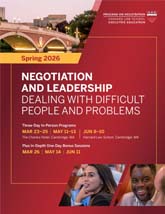
The Program on Negotiation’s Executive Education negotiation training programs include Negotiation and Leadership: Dealing with Difficult People and Problems, the Harvard Negotiation Master Class, and the Harvard Mediation Intensive.
This training allows negotiators to:
Should you anchor with a single number or a range? Learn how bolstering ranges use anchoring bias to improve negotiation outcomes. … Learn More About This Program
Learn the 4 elements of principled negotiation from Getting to Yes—and how focusing on interests, options, and BATNA leads to better deals. … Learn More About This Program
Question: I am in my final year of business school and starting to prepare for job interviews. I have heard many of the organizations that recruit on campus are not open to negotiating specific terms of employment. Rather, they offer everyone roughly the same deal terms. To what extent should I respect such conventions versus … Read When a Job Offer is “Nonnegotiable”
Everything good comes in threes, they say. For storytellers, this means understanding that readers and listeners find a sequence of three things to be memorable, satisfying, and compelling—whether it’s three bears, three little pigs, or three kings. For professional negotiators, sequences of three can be rewarding as well. The following examples of good negotiation skills … Learn More About This Program
Can humor improve negotiation outcomes? Research shows well-timed humor builds trust, creativity, and rapport—when used strategically. … Learn More About This Program
When we think of failed business negotiations, most of us picture negotiators walking away from the table in disappointment. But that’s only one type of disappointing negotiation. Failed business negotiations also include those that parties come to regret over time and those that fall apart during implementation. The following three types of negotiation failures are … Read Why Negotiations Fail
Is one negotiation style better? Learn how balancing cooperation and assertiveness leads to stronger outcomes and lasting business relationships. … Learn More About This Program
Learn what integrative bargaining is, how it differs from distributive negotiation, and how to create win-win value in business deals. … Learn More About This Program
Learn how price anchoring shapes negotiations, when to make the first offer, and how precise and range anchors can improve your outcomes. … Read Price Anchoring 101
In their revolutionary book Getting to Yes: Negotiating Agreement Without Giving In (Penguin, 3rd edition, 2011), Roger Fisher, William Ury, and Bruce Patton introduced the world to the possibilities of mutual-gains negotiation, or integrative negotiation. The authors of Getting to Yes explained that negotiators don’t have to choose between either waging a strictly competitive, win-lose … Read Six Guidelines for “Getting to Yes”

 BATNA
Business Negotiations
Conflict Resolution
Crisis Negotiations
Dealing with Difficult People
Dealmaking
Dispute Resolution
International Negotiation
Leadership Skills
Mediation
Negotiation Skills
Negotiation Training
Salary Negotiations
Teaching Negotiation
Win-Win Negotiations
BATNA
Business Negotiations
Conflict Resolution
Crisis Negotiations
Dealing with Difficult People
Dealmaking
Dispute Resolution
International Negotiation
Leadership Skills
Mediation
Negotiation Skills
Negotiation Training
Salary Negotiations
Teaching Negotiation
Win-Win Negotiations
Lost your password? Create a new password of your choice.
Copyright © 2026 Negotiation Daily. All rights reserved.