


Increasingly, business negotiators recognize that the most effective bargainers are skilled at both creating value and claiming value—that is, they know how to collaborate and compete at the same time. This balance lies at the heart of integrative negotiation, where parties work to expand the pie before dividing it.
The following 10 negotiation skills will help you succeed at integrative negotiation while still protecting your interests.
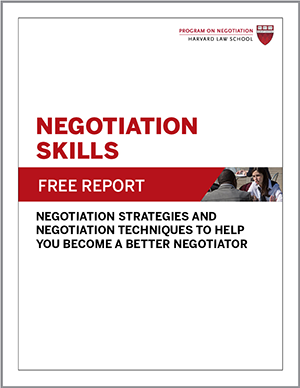
Claim your FREE copy: Negotiation Skills
Build powerful negotiation skills and become a better dealmaker and leader. Download our FREE special report, Negotiation Skills: Negotiation Strategies and Negotiation Techniques to Help You Become a Better Negotiator, from the Program on Negotiation at Harvard Law School.
1. Analyze and cultivate your BATNA. In both integrative negotiation and adversarial bargaining, your best source of power is your ability—and willingness—to walk away and pursue another deal. Before coming to the table, skilled negotiators spend time identifying their best alternative to a negotiated agreement (BATNA) and, whenever possible, taking steps to strengthen it.
A strong BATNA not only improves your leverage; it also helps you negotiate with confidence rather than desperation.
2. Negotiate the process. Don’t assume you and your counterpart share the same expectations about how negotiations will unfold. Instead, negotiate the process before negotiating substance.
Clarify issues such as:
- When and how often you’ll meet
- Who will be present
- What topics will be discussed and in what order
Addressing these procedural questions early can prevent misunderstandings and clear the way for more productive discussions.
3. Build rapport. Although it’s not always practical to engage in small talk—especially under tight deadlines—even a few minutes of rapport building can pay dividends. Research suggests negotiators are more collaborative and more likely to reach agreement when they make a modest effort to get to know one another.
If you’re negotiating virtually or over email, a brief introductory phone or video call can help humanize the interaction. This is one of the most consistently valuable negotiation skills to master.
4. Listen actively. Once substantive talks begin, resist the temptation to plan your response while the other party is speaking. Instead, focus fully on what she is saying.
Try to:
- Paraphrase her main points to confirm understanding
- Acknowledge emotions such as frustration or concern
- Ask follow-up questions that clarify interests
Active listening not only uncovers useful information—it often encourages the other side to listen just as carefully in return.
5. Ask good questions. Integrative negotiation thrives on information, and good questions are how you get it.
Avoid:
- Yes-or-no questions
- Leading questions (“Don’t you think…?”)
Instead, ask neutral, open-ended questions that invite detail, such as:
“Can you tell me more about the challenges you’re facing this quarter?”
Thoughtful questioning helps reveal priorities, constraints, and opportunities for value creation.
6. Search for smart tradeoffs. In distributive negotiations, parties often haggle over a single issue, such as price. Integrative negotiations, by contrast, typically involve multiple issues—and that creates opportunity.
Look for differences in preferences. Identify issues your counterpart values highly but that matter less to you, and vice versa. Then propose trades that give each side more of what it values most, rather than splitting the difference across the board.
7. Be aware of the anchoring bias. Research shows that the first number mentioned in a negotiation—no matter how arbitrary—can strongly influence what follows.
When possible, make the first offer to anchor the discussion in your preferred range. If the other party anchors first, pause to revisit your goals, your BATNA, and your target outcomes so you’re not pulled off course by an aggressive opening.
8. Present multiple equivalent offers simultaneously (MESOs). Rather than putting one offer on the table at a time, consider presenting several multiple equivalent offers simultaneously.
If your counterpart rejects all of them, ask which one came closest and why. This feedback provides valuable insight into their preferences and can spark creative problem-solving. MESOs also reduce the risk of impasse by shifting the conversation away from yes-or-no decisions.
9. Try a contingent contract. Negotiators often reach stalemate because they disagree about how the future will unfold. In such cases, a contingent contract can help.
A contingent contract is essentially a bet on future outcomes. For example, if you doubt a contractor’s claim that a project will be finished in three months, propose incentives for early completion and penalties for delays. If the contractor truly believes his timeline, he should be comfortable accepting such terms.
10. Plan for the implementation stage. Another way to improve the long-term durability of your contract is to place milestones and deadlines in your contract to ensure that commitments are being met. You might also agree, in writing, to meet at regular intervals throughout the life of the contract to check in and, if necessary, renegotiate.
In addition, adding a dispute-resolution clause that calls for the use of mediation or arbitration if a conflict arises can be a wise move.
What negotiation skills would you add to this list? Leave us a comment.
Claim your FREE copy: Negotiation Skills
Build powerful negotiation skills and become a better dealmaker and leader. Download our FREE special report, Negotiation Skills: Negotiation Strategies and Negotiation Techniques to Help You Become a Better Negotiator, from the Program on Negotiation at Harvard Law School.




Great list of essential negotiation skills! Building rapport and active listening are such underrated yet powerful tools in creating trust during any negotiation. Crafting multiple offers at once is a smart move to keep talks flexible and creative. And having a solid BATNA is always a game-changer in staying confident at the table. It’s all about balancing collaboration and competition to find win-win solutions!
Great article! Will try to learn these skills!
What has fascinated me since I attended Dr. Mandell’s class is the extent to which negotiation permeates our daily lives. It appears that many individuals are unaware of just how many things are, or should ideally be, outcomes of negotiation. Too often, people assume that negotiation only occurs when parties explicitly declare, ‘We are now going to negotiate.’ When I delivered a presentation based on what I learned in class, it took some time for the audience to recognize how numerous aspects of both their professional and personal lives are shaped by implicit negotiation.
Extremely helpful information.
excellent
What has been interesting to me since I took Dr. Mandell’s class is how much negotiation is part of everyday life. Few people seem to realize how many things are, or at least should be, the result of a negotiation. Too many think that no negotiation is involved unless the parties say, “OK, we are going to now negotiate.” I gave a talk based on what I learned in class and it took a while for people to see how many more aspects of both their professional and personal lives are the result of implicit negotiation.
I would like to have permission to pass your 10 skills along to some of our top business customers. Would that be possible?
Hello,
All of our content is free and can be passed along.
Please send me more information.
Hello,
You can find more information about our courses in the Executive Education section of our website.
Except when it’s a ridiculously low offer. Your opponent will always find a way to justify even a ridiculous offer, and, if you start a conversation on such an offer, you have been anchored! Find a way to ignore the low offer, such as pretending you didn’t hear it?
Have a well planned concession strategy:
1. Take the time to think about what concessions the other side might ask of you.
2. Leave yourself room – this means you better understand how to anchor and where your target is for a great outcome.
3. Rationalize your concessions to avoid the” buffoon factor” and cause credibility loss. You don’t want to be arbitrary.
4. Take careful consideration on how big or small your concessions should be…there is an entire process for this.
5. Ask for something in return…this should be an exchange of valuable assets to help both parties meet their most important priorities.
With regards to anchoring if you are victim to it, an effective antidote is to insist on justification by asking “it would be helpful to us if you could explain how you arrived at that value?”. This completely neutralizes the anchoring effect! Try it! It works like magic!!
I had a book of yours it was a short read, concise, I loved it! Thank u! Management book from Barnes n noble.