


What negotiation skills lead to optimal negotiated agreements and support true win-win negotiations?
One of the most powerful—and often overlooked—skills is active listening. Few negotiators dispute the value of strong listening skills. Skillful active listening can calm tensions, break impasses, and uncover the information needed to build creative, mutually beneficial deals.
Yet most of us overestimate how well we listen. At the same time, many negotiators misunderstand what active listening actually involves.
Quick Answer: Why Is Active Listening So Important in Negotiation?
Active listening helps negotiators:
- Reduce defensiveness and tension
- Clarify misunderstandings
- Uncover hidden interests and concerns
- Build trust and rapport
- Open the door to creative, win-win solutions
In short, when people feel heard, they become more willing to collaborate.
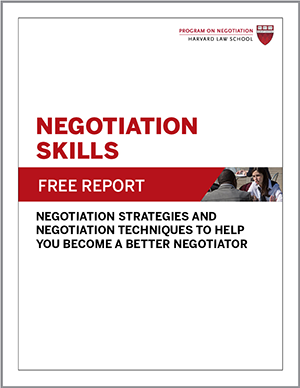
Claim your FREE copy: Negotiation Skills
Build powerful negotiation skills and become a better dealmaker and leader. Download our FREE special report, Negotiation Skills: Negotiation Strategies and Negotiation Techniques to Help You Become a Better Negotiator, from the Program on Negotiation at Harvard Law School.
Three Listening Skills for Successful Negotiations
Contrary to popular belief, active listening does not mean sitting patiently while your counterpart talks. Nor does it simply involve nodding, maintaining eye contact, or saying, “I understand.”
Active listening is a dynamic process built on three key behaviors:
- Paraphrasing
- Inquiry
- Acknowledgment
Used together, these skills allow negotiators to gather critical information while keeping conversations constructive and forward-looking.
A Negotiation Example: Active Listening in Action
Suppose you supply a state-of-the-art component for a new medical imaging device and submit a written sales proposal to a manufacturer.
At your first meeting, the buyer’s representative responds:
“Your proposal doesn’t give us the assurances we need that you can ramp up production if demand skyrockets. Frankly, your price per unit is unacceptable. We think you have a terrific product, but if you’re not going to work with us, we’re prepared to find someone who will.”
Rather than reacting defensively, an effective negotiator uses active listening techniques to move the conversation forward.
Paraphrase: Confirm Understanding
You might begin by paraphrasing:
“It sounds as if you’re satisfied with our component overall. But if I understand correctly, you need reassurance that we can increase production if orders grow quickly. You’re also concerned about our proposed per-unit price and whether we’re willing to work with you toward a workable arrangement. Have I captured your main points?”
Paraphrasing confirms understanding and allows the other side to clarify or correct details before tensions rise.
Inquire: Ask Questions to Learn More
Next, shift to inquiry:
“You mentioned our price is unacceptable. Could you help me understand how you arrived at that conclusion? And perhaps we can explore pricing structures that better fit your needs.”
Questions encourage dialogue and surface the interests behind positions.
Acknowledge: Recognize Emotions and Concerns
Finally, acknowledgment helps address emotional undercurrents:
“It sounds as if you’re quite disappointed with parts of our proposal and concerned about whether we can build a strong long-term relationship.”
Acknowledgment doesn’t mean agreement. It signals that you recognize the other party’s concerns—an important step toward joint problem-solving.
Bringing the Skills Together
Skillful negotiators orchestrate paraphrasing, inquiry, and acknowledgment to draw out the other party’s concerns and motivations. Once those concerns are clear, negotiators can share their own perspective and begin collaborative problem-solving.
In many negotiations, progress begins not when someone argues more forcefully—but when someone listens more effectively.
Final Thought
Active listening is not passive. It is one of the most strategic negotiation tools available—and one of the most reliable ways to move discussions toward mutually beneficial agreements.
How do you use active listening in your own negotiations?
Claim your FREE copy: Negotiation Skills
Build powerful negotiation skills and become a better dealmaker and leader. Download our FREE special report, Negotiation Skills: Negotiation Strategies and Negotiation Techniques to Help You Become a Better Negotiator, from the Program on Negotiation at Harvard Law School.
Adapted from “Listen Up! Your Talks May Depend on It,” by Robert C. Bordone (Senior Fellow, Harvard Law School), first published in the Negotiation newsletter.




THANK YOU; FANTASTIC; SUPER RAW CLEAR TO THE ROOT ! ( as PRACTIAL as I did “Applied” it Today & Closed The DEAL )
We’re a group of volunteers and starting a new scheme in our
community. Your site provided us with valuable information to work on.
You’ve done a formidable job and our entire community will
probably be thankful to you.