


Negotiation research suggests that handling negotiations over email often creates more problems than advantages, particularly when it comes to relationship building, information exchange, and reaching high-quality outcomes in conflict resolution negotiations scenarios. While email can be efficient, the medium also amplifies misunderstandings and makes it harder for trust to take root.
One immediate challenge is the difficulty of establishing social rapport via email. Without nonverbal cues—tone of voice, facial expressions, posture—and with few shared norms governing how email should be used in negotiation, messages can easily come across as curt, inattentive, or even hostile. This absence of visible empathy often leads negotiators to be less polite and less attentive to the other side’s concerns, increasing the likelihood of tension or escalation before substantive issues are addressed.
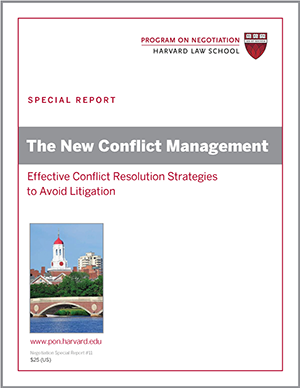
Claim your FREE copy: The New Conflict Management
In our FREE special report from the Program on Negotiation at Harvard Law School - The New Conflict Management: Effective Conflict Resolution Strategies to Avoid Litigation – renowned negotiation experts uncover unconventional approaches to conflict management that can turn adversaries into partners.
Email negotiations are also especially vulnerable to misunderstanding because emotion and intent are hard to convey accurately—and because negotiators frequently fail to consider how their messages will be interpreted. Compounding the problem, people tend to be unaware of just how limited email communication can be.
In a study by Justin Kruger of New York University, Nicholas Epley of the University of Chicago, and Justin Parker and Zhi-Wen Ng of the University of Illinois at Urbana-Champaign, participants were asked to communicate statements expressing sarcasm, seriousness, anger, or sadness to either a friend or a stranger. The messages were delivered via email, over the phone, or face-to-face.
Across conditions, individuals consistently overestimated how accurately recipients would interpret their intended tone. This overconfidence was present whether the recipient was a friend or a stranger, but it was strongest in email communication. As a result, email negotiations often suffer from reduced information exchange, higher rates of impasse, and less efficient agreements compared with negotiations conducted in person or even by phone.
How Do You Grapple with Concealed Information in Business Negotiations?
In our related conflict resolution article, Concealed Information in Business Negotiations, we discuss a negotiation role-play simulation, Bullard Houses. Business negotiators not only learn how to deal with counterparts that are concealing information at the bargaining table, but also how what, and when to reveal critical information during tense, real-life negotiation scenarios.
Drawn from the latest in bargaining research, Bullard Houses is part of the Teaching Negotiation Resource Center’s set of negotiator’s role-play simulations developed to perfecting bargaining and negotiation skills.
Bullard Houses can be run as a one-on-one negotiation simulation between two negotiators or it can be expanded into team building exercises pitting two groups of competitive negotiators against one another in a contentious housing dispute.
The following themes are addressed by Bullard Houses attorney/client relations:
- A negotiator’s best alternative to a negotiated agreement (BATNA)
- The role of confidentiality in business negotiations
- Information exchange and strategic disclosure
- The use of agents in negotiations
- Interpreting and analyzing counterpart messages
- Grappling with misrepresentation and intentional obfuscation
- Evaluating objective criteria
- The impact of political and organizational constraints
- Managing negotiations involving undisclosed principals
Together, these lessons highlight why negotiators should be cautious about relying too heavily on email—especially when trust, nuance, and complex information are at stake.
Do you have any stories to share about negotiations over email? How have they worked out for you?
Claim your FREE copy: The New Conflict Management
In our FREE special report from the Program on Negotiation at Harvard Law School - The New Conflict Management: Effective Conflict Resolution Strategies to Avoid Litigation – renowned negotiation experts uncover unconventional approaches to conflict management that can turn adversaries into partners.
Originally published in 2012.




This is so true–keep up the good work!