


Some negotiators seem to believe that hard-bargaining tactics are the key to success. They resort to threats, extreme demands, and even unethical behavior to try to get the upper hand in a negotiation.
In fact, negotiators who fall back on hard-bargaining strategies are typically betraying a lack of understanding about the gains that can be achieved in most business negotiations. When negotiators rely on hardball tactics, they signal that they view negotiation as a win-lose enterprise.
To be fair, a small percentage of business negotiations do fit this mold. Negotiations focused on a single issue—most commonly price—can legitimately resemble win-lose contests. These are known as distributive negotiations, and even today they remain a reality in certain contexts.
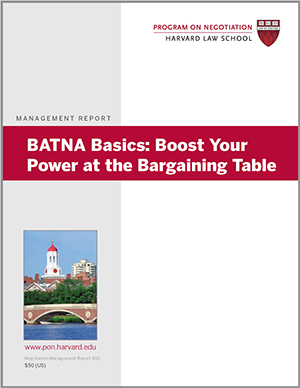
Claim your FREE copy: BATNA Basics
Discover how to unleash your power at the bargaining table in this free special report, BATNA Basics: Boost Your Power at the Bargaining Table, from Harvard Law School.
Much more commonly, however, business negotiations involve multiple issues: timing, risk, scope, relationships, future opportunities, and non-monetary value. These integrative negotiations give parties the opportunity to create win-win outcomes and mutually beneficial agreements.
In such negotiations, business negotiators can achieve better results by brainstorming creative solutions, identifying differences in preferences that invite trade-offs, and building trust over time. These skills are not soft alternatives to bargaining strength—they are sources of real leverage.
Unfortunately, when parties resort to hard-bargaining tactics in negotiations with integrative potential, they risk missing out on these benefits. Because negotiators tend to respond in the way they are treated, one party’s negotiation hardball tactics can create a vicious cycle of threats, demands, and other hardball strategies. This pattern can create a hard-bargaining negotiation that easily deteriorates into impasse, distrust, or a deal that’s subpar for everyone involved.
10 Common Hard-Bargaining Tactics & Negotiation Skills
To prevent your negotiation from sliding into hard-bargaining mode, the first step is a personal one: make a conscious commitment not to engage in these tactics yourself. In most cases, there are better ways to meet your goals—by building trust, asking thoughtful questions, and exploring differences rather than fighting over positions.
The second step is preparation. You need to anticipate your counterpart’s use of hard-bargaining tactics and be able to recognize them when they appear.
In their book Beyond Winning: Negotiating to Create Value in Deals and Disputes, Robert Mnookin, Scott Peppet, and Andrew Tulumello offer practical advice for avoiding ambush by hard bargainers. The better prepared you are for hard-bargaining strategies, the more effectively you can defuse them without escalating conflict.
Here are 10 common hardball tactics in negotiation to watch for:
- Extreme demands followed up by small, slow concessions. Perhaps the most common hard-bargaining tactic, this approach is designed to anchor the negotiation aggressively and discourage quick concessions. While it may protect one side from moving too fast, it can stall negotiations or derail them altogether.
How to respond: Know your goals, your BATNA (best alternative to a negotiated agreement), and your bottom line—and don’t let an aggressive opening rattle you. - Commitment tactics. Your counterpart may claim that their hands are tied or that they lack authority to negotiate.
How to respond: Test whether the commitment is real. If necessary, ask to involve someone with greater decision-making authority. - Take-it-or-leave-it offers. Offers are rarely truly nonnegotiable.
How to respond: Ignore the ultimatum language and focus on the substance of the offer. Counter with a proposal that addresses both parties’ interests. - Inviting unreciprocated offers. Your counterpart asks you to concede before making a counteroffer.
How to respond: Don’t bid against yourself. Make it clear you are waiting for a reciprocal offer. - Trying to make you flinch. Escalating demands are used to see how much pressure you can tolerate.
How to respond: Name the tactic and clarify that you will only engage in reciprocal exchanges. - Personal insults and feather ruffling. Personal attacks are meant to provoke emotional reactions and weaken your position.
How to respond: Take a break if needed and set clear boundaries. You are not obligated to tolerate disrespect. - Bluffing, puffing, and lying. Exaggerated claims and misrepresentations can throw negotiations off track.
How to respond: Be skeptical of statements that sound too good—or too dire—to be true, and verify key information. - Threats and warnings. Overt or subtle threats are designed to force compliance.
How to respond: Recognize them for what they are. Naming or calmly ignoring a threat can neutralize its power. - Belittling your alternatives. Your counterpart may try to undermine your confidence in your BATNA.
How to respond: Don’t let them define your options for you. Stay grounded in your own assessment. - Good cop, bad cop. One negotiator plays reasonable while the other plays tough.
How to respond: Remember that they are working together. Don’t be distracted by the performance.
Have you encountered other hard-bargaining strategies in negotiation that you would add to this list? We’d love to hear from you.
Claim your FREE copy: BATNA Basics
Discover how to unleash your power at the bargaining table in this free special report, BATNA Basics: Boost Your Power at the Bargaining Table, from Harvard Law School.




Very useful tactics! Great breakdown of hardball negotiation strategies — practical and insightful.
A masterclass in negotiation strategy! This piece highlights the importance of preparation and awareness when facing tough opponents. Whether you’re in business or daily life, these tactics teach you how to stay composed and think strategically under pressure.
Bargaining tactics can be a game-changer in negotiations, staying vigilant against them is key for success.
This article provides an invaluable guide for recognizing and navigating through the maze of hardball tactics often encountered in negotiations. The detailed breakdown of each tactic not only prepares negotiators to identify them but also offers strategies to effectively counter these approaches. It’s a reminder that understanding and preparation are key to maintaining a level-headed approach in the face of potentially aggressive and unethical negotiation strategies. This insight is particularly valuable in fostering an environment where mutually beneficial outcomes can be achieved despite the challenges. Excellent and practical advice for any negotiator.
In a negotiation, being aware of hard-bargaining tactics is crucial. Watch out for tactics such as ‘highballing’ (starting with an unrealistically high offer), ‘lowballing’ (initially offering too low), ‘good cop, bad cop’ (using a friendly and a tough negotiator), and ‘nibbling’ (making small last-minute demands). ‘Silent treatment,’ ‘time pressure,’ ‘appeal to higher authority,’ ‘flinching,’ ‘straw man,’ and ‘exploding offer’ are other tactics to recognize. Being vigilant can help you respond effectively, maintain fairness, and achieve a mutually beneficial agreement during negotiations.
If the “other side” is your “opponent” then you are not negotiating, you are engaged in warfare. There is no trust, no reasonableness, and no common set of interests. This is not a negotiation; it’s a battle of power, a game of wits, a test of wills, and a mastery of manipulation. Recognize the “opponent” is trying to conquer you, and negotiations are simply a deception to give the false illusion that a reasonable outcome is possible.
Whoever is destined to lose will lose big-time unless they increase the power-balance on their side.
Also, recognize that value will actually be destroyed in this process – it will more than likely devolve into a lose-lose.
These rules of engagement were used by Ignacio Lopez at General Motors in the 1990s, and it resulted in poor quality cars to the extent that warranty costs exceeded profits year after year.
It makes a lousy procurement strategy and is likely to result in higher total costs of ownership, which seldom get considered in the heat of the battle.
If you get caught in this mess, it’s better to walk away and do business with reputable, trustworthy business entities.
This article assisted me during my procurement assignment, cheers to the author
This article assisted me during my procurement assignment, cheers to the author
This article assisted me during my procurement assignment, cheers to the author
As negotiation prof, it’s tricky to teach these concepts without addressing how various national & international “leaders” uses these tactics. I can teach students not to use or bend to them, but they see it being used by people to maintain and acquire power. This mismatch of what I say and what they see must be addressed.
This article assisted me during my procurement assignment, cheers to the author
Never knew that seating plan can have this big effect. Excellent example and beautiful explanation
An excellent summation of the Harvard Method. I imagine that your counter-parts enjoy reaching mutually beneficial agreements with you.
In other words, the Trump Negotiation Method. Good article. Thank you.
my rules of bargaining are simple.
1. understand what you want to achieve.
2. understand what the other side wants to achieve
3. understand the why for both
4. understand each other’s walk away point
5. negotiate, negotiate, negotiate, negotiate
6. never let the other side walk away empty handed.
7. never go into a negotiation you are not prepared to walk away from.
All excellent points.Well done
There are two general types of bargaining, distributive bargaining and integrative bargaining.
Recently found this post. It’s a great list. I tend to think, based upon experience that negotiation is as much about education as it is about preparation. Preparation is key – knowing your worth, knowing your industry and knowing your negotiating partner’s industry and needs. But I find the best way to reach the maximum potential of any negotiation is when you are controlling the narrative and educating your negotiating partner in a persuasive manner. Here is a blog I recently wrote discussing that sort of preparation and education. http://www.thenewyorklawblog.com/2016/07/negotiation-basics-newyork-small-business.html
This is a helpful list.
I understand the point about bidding against oneself, but there are times when it is to your advantage. Let’s say your “opponent” makes a very high anchor; you counter with a very low anchor. Let’s say your “opponent” says “you have to do better.” It is to your advantage that your opponent has accepted your anchor as the focal point rather than his high anchor. It is easier to inch up to find the other person’s reservation price, than having to work down from a high first offer. I would just as soon my opponent not hold on to his anchor but rather accepts mine. If that means bidding against myself, so be it.
Very astute comment. Thank you.
I loved the article! I believe in negociation!