In their book Difficult Conversations: How to Discuss What Matters Most (Penguin Putnam, 2000), authors Douglas Stone, Bruce Patton, and Sheila Heen explain how to engage in the conversations—professional and personal—that most of us would rather avoid. By examining a practical case study in conflict management, they show that tough, honest conversations are not just unavoidable but essential.
For managers, these conversations are especially critical. Whether the task is changing group culture, managing conflict within a team, delivering a negative performance review, disagreeing with colleagues, or offering an apology, avoiding the conversation rarely makes the problem go away. More often, it makes it worse.
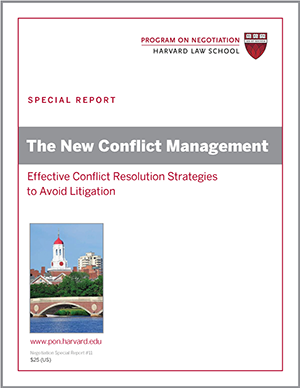
Claim your FREE copy: The New Conflict Management
In our FREE special report from the Program on Negotiation at Harvard Law School - The New Conflict Management: Effective Conflict Resolution Strategies to Avoid Litigation – renowned negotiation experts uncover unconventional approaches to conflict management that can turn adversaries into partners.
The “Third Story”: A Better Way to Begin
To set the stage for a productive discussion, the authors recommend opening a difficult conversation with what they call the Third Story. The Third Story is the version of events that a neutral observer—such as a mediator—might tell. It’s not your story or their story, but a framing of the situation that both sides can recognize as legitimate.
“The key is learning to describe the gap—or difference—between your story and the other person’s story,” Stone, Patton, and Heen write. “Whatever else you may think and feel, you can at least agree that you and the other person see things differently.”
A Simple Workplace Example
Consider a familiar workplace scenario. Two regional sales representatives share responsibility for sending weekly updates to their manager. Brad always submits the reports on time. Frank, however, frequently turns them in late.
If Brad opens the conversation by saying, “Frank, you’ve turned in the sales reports late again,” Frank is likely to feel accused and put on the defensive. The conversation stalls before it even begins.
Instead, Brad tries a Third Story opening:
“Frank, you and I seem to place a different value on deadlines. I want to explain why meeting them is important to me, and then I’d like to hear your perspective.”
This framing acknowledges a difference without assigning fault. As a result, Brad learns something important: when Frank is faced with a choice between pursuing a promising sale or stopping to complete the report, he prioritizes the sale.
Armed with this insight, Brad proposes a creative solution. When it’s Frank’s turn to complete the report, Brad will handle it—provided Frank gives him two hours’ notice and agrees to share any commission earned from continuing to pursue the lead. The arrangement respects both priorities and turns a point of friction into a workable agreement.
Why This Approach Works
The Third Story works because it:
- Reduces defensiveness by avoiding blame
- Signals curiosity rather than judgment
- Creates space for problem-solving instead of argument
- Helps uncover underlying interests that invite creative solutions
Rather than debating who is “right,” the conversation becomes about how to move forward together.
What conflict management approaches have you found most effective when conversations get uncomfortable?
Related Conflict Resolution Article: Conflict Management Skills When Dealing with an Angry Public – Here is some negotiation advice drawn from a case study of conflict management dealing with an angry public.
Claim your FREE copy: The New Conflict Management
In our FREE special report from the Program on Negotiation at Harvard Law School - The New Conflict Management: Effective Conflict Resolution Strategies to Avoid Litigation – renowned negotiation experts uncover unconventional approaches to conflict management that can turn adversaries into partners.
Adapted from “How to Say What Matters Most,” by Susan Hackley (former managing director, Program on Negotiation), first published in the Negotiation newsletter.
Originally published in 2010.