


Upset by a delay in the delivery of one of your products, a longtime buyer threatens to go public—or turn to the media—unless you meet his extreme demands. Suddenly, not only is the relationship at risk, but your company’s reputation may be on the line as well.
What should you do?
Surprisingly, one useful place to look is hostage negotiation strategy.
Before dismissing life-and-death negotiations as irrelevant to your professional life, consider the practical lessons crisis negotiators have learned. The techniques used to calm dangerous confrontations often translate well to business disputes, customer crises, and high-pressure negotiations.
In fact, many experts note that the same elements appear in both situations: high stakes, emotional intensity, limited preparation time, multiple decision makers, and outside interference.
And in today’s social media environment, business conflicts can escalate just as quickly as physical crises.
Why Crisis Negotiation Techniques Work in Business Disputes
Hostage negotiators train to handle situations where emotions are extreme and mistakes carry enormous consequences. While business negotiations are rarely so dramatic, the psychological dynamics are often similar.
Common features include:
- Heightened emotions
- Urgency and pressure
- Threats or ultimatums
- Limited time to prepare
- Multiple stakeholders
- Fear of reputational damage
- Outside audiences influencing outcomes
Because of these similarities, crisis negotiation techniques can help negotiators navigate tense professional situations more effectively.
Five Hostage Negotiation Techniques You Can Use at Work
The Negotiation Briefings newsletter has outlined five hostage negotiation strategies that also help diffuse professional negotiation crises.
1. Gain Control Through One-on-One Communication
In chaotic situations, too many voices increase confusion and escalation. Crisis negotiators work to establish a single line of communication.
In business disputes, designate one calm, trusted representative to speak with the upset party. This reduces miscommunication and emotional escalation.
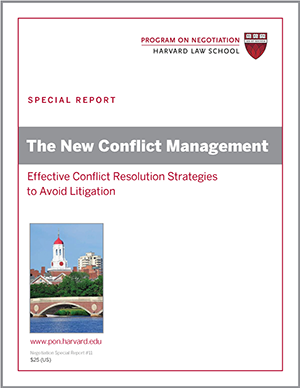
Claim your FREE copy: The New Conflict Management
In our FREE special report from the Program on Negotiation at Harvard Law School - The New Conflict Management: Effective Conflict Resolution Strategies to Avoid Litigation – renowned negotiation experts uncover unconventional approaches to conflict management that can turn adversaries into partners.
2. Explore the Emotions Behind the Demands
Extreme demands are often driven by fear, frustration, or a desire to be heard.
Instead of arguing immediately over terms, ask questions:
- What concerns are driving this reaction?
- What outcome are they truly seeking?
- What problem are they trying to solve?
Often, once emotions are acknowledged, demands soften.
3. Let Time Help Defuse Emotion
In hostage negotiations, time is often an ally. As emotions cool, parties become more rational.
In business disputes, rushing to “fix” the issue can worsen matters. Allowing time for emotions to settle often produces more constructive conversations.
Patience is frequently more powerful than speed.
4. Help Solve Immediate Problems
Crisis negotiators focus on addressing short-term needs that lower tension.
Similarly, in business disputes, look for ways to solve urgent concerns:
- Offer interim solutions
- Provide updated timelines
- Create temporary workarounds
- Show visible efforts to fix the problem
Progress reduces panic.
5. Allow the Other Side to Save Face
Even when you secure a favorable outcome, helping the other side maintain dignity preserves relationships.
Allowing a counterpart to explain the resolution positively—to customers, leadership, or the public—makes future cooperation more likely.
Winning publicly at someone else’s expense often damages long-term relationships.
The Power of Patience in Difficult Negotiations
Few business negotiations last the 50 hours or more that some hostage negotiators endure. Still, their example offers an important lesson: patience and perseverance often resolve conflicts that force cannot.
Over time, anger tends to subside, positions soften, and creative solutions become possible.
When tensions run high, slowing down is usually wiser than rushing to closure.
Do you rely on any of these advanced negotiation strategies at the bargaining table? Share your experiences in the comments.
Claim your FREE copy: The New Conflict Management
In our FREE special report from the Program on Negotiation at Harvard Law School - The New Conflict Management: Effective Conflict Resolution Strategies to Avoid Litigation – renowned negotiation experts uncover unconventional approaches to conflict management that can turn adversaries into partners.
Related Articles:
How to DEAL with Threats – Here is a four-step process for dealing with threats from your counterpart at the negotiation table. While all negotiators will face difficult people in their careers, few have honed their ability to deal with uncooperative counterparts and may risk having their negotiations derailed if they respond to threats and belligerence ineffectively. Learn how threats impact the negotiation process and what integrative negotiators can do to head off the threat, neutralize it, and get negotiations back on track.
Think Like a Hostage Negotiator – Crisis negotiations, unlike many negotiation scenarios you will face, are high-pressure, intense situations sometimes involving life or death. As different as these scenarios may sound from a commercial or sales negotiation situation, there are many negotiation skills and negotiation tactics that hostage negotiators use that have real applicability for negotiators of all backgrounds.
Negotiation Skills: Threat Response at the Bargaining Table – Responding to threats in an effective manner is an essential skill for crisis negotiators but also has use for business negotiators and diplomats as well. Learn negotiating skills and negotiation tactics for dealing with threats at the negotiation table in an effective manner.
Police Negotiation Techniques and Negotiation Skills from the New York City Police Department Hostage Negotiations Team – Few teams of hostage negotiators have more experience in the field than the NYPD. In this article, we explore the negotiation strategies and negotiating tactics employed by the New York City Hostage Negotiations Unit, a part of the New York City Police Department.
With No Good BATNA, Police Negotiators Accept Texts – Text messaging and communication through electronic devices changes the dynamics of negotiation quite fundamentally. In this article we explore how police forces around the United States are embracing new technologies in order to talk with their counterparts in crisis negotiations.
Top 10 Business Negotiations of 2013 – Here is a list of the Program on Negotiation’s top ten business negotiations for 2013. From sales negotiations to international negotiations, these are the top negotiation case studies, news, and negotiation research for the year 2012.
Claim your FREE copy: The New Conflict Management
In our FREE special report from the Program on Negotiation at Harvard Law School - The New Conflict Management: Effective Conflict Resolution Strategies to Avoid Litigation – renowned negotiation experts uncover unconventional approaches to conflict management that can turn adversaries into partners.
Originally published in 2009.




As someone who works with negotiators in high-stakes commercial environments, I appreciate how effectively this article reframes “hostage negotiation” as an emotional and structural problem rather than a tactical one. The parallels are real: time pressure, public threats, ego, and fear of loss all push people toward extreme positions.
In my experience, the most underused ideas here are slowing the process down and helping the other side save face. Business negotiators often rush to “solve” the issue, when patience itself is the de-escalation tool. Likewise, face-saving isn’t weakness—it’s often the price of agreement when emotions are running hot.
Exploring the feelings behind demands is also critical. Extreme positions are rarely about the demand itself; they’re about control, status, or perceived disrespect. When those drivers are addressed, the deal space usually reopens.
Great reminder that the best negotiators don’t overpower crises—they stabilize them first.
Great text and comment.
I would add the good practice in hostage negotiations of trying to make your counterpart focus on the desired outcome and then negotiate step by step on whichever action or agreement will help us get closer to it.
Another option, in case the other is at least a little open to dialogue, is to make a mutual agreement to leave out any action that will difficult a good outcome.
That would sound like this: we will do everything on our hands to find a good way to get through this difficulty, but we both have to agree on some principles to look from now on: we will not use threats, manipulation, hostility or power display as means for getting a result, not only because the outcome might damage one or both of us, but also because it would lead us apart from the main objective for which we are in this situation.
I never considered that hostage negotiation could be used in real life. But now after reading this post I can see it is exactly the same type of situation. Very nice and informative post.
I also found Thomas Strentz’s book, The Psychological Aspects of Crisis Negotiation, to be very useful in identifying the key team roles that should be filled in a crisis negotiation. Several of these roles may be filled by the same person or multiple persons, but all should be identified & covered in a crisis. When a complex, fast moving crisis negotation in a commercial setting unfolds I found these FBI-oriented team roles to have useful analogues in the business world:
1. Lead negotiator
2. Secondary negotiator
3. Information officer (to coordinate the collection of key information needed by the negotiating team)
4. Think tank (to help process information & demands coming in; to brainstorm & offer ideas to the lead negotiator & team for how best to respond to the latest developments)
5. tactical liaison (to keep other parts of the company informed and integrated into the latest thinking & developments in the negotiations)
6. Chronographer (to establish an up to date information recording system that enables all relevant stakeholders in the company to know what the latest status, developments, demands and deadlines are)
7. behavioral science expert/interpreter (someone who is familiar with the counter party’s language and culture, who can help interpret the demands and views coming in from the other side)
8. Messenger (someone to coordinate the efficient transmission of messages to other parts of the company and/or to the appropriate representatives of the counter party)
9. guard (someone to tactfully deal with interlopers; to help keep the crisis room clear from disruptions and interested onlookers who would like to know what is happening but whose interruptions threaten to undermine the negotiation team’s ability to focus & deal with the crisis)
10. Technician (someone standing by with the appropriate technical skills who can help with any IT systems that break down during the negotiations)