


Most negotiations require two very different—sometimes opposing—skills: collaboration and competition. To reach strong agreements, we often need to work with others to uncover new sources of value while also competing with them to claim as much of that value as possible.
Before mastering the intricacies of value creation, however, it helps to build a solid foundation in value claiming. In this article, we answer a basic but essential question—What is distributive negotiation?—and outline five proven strategies for succeeding in value-claiming negotiations.
What is Distributive Negotiation?
Distributive negotiation is the process of dividing up a fixed amount of value—often described as “splitting the pie.” It’s the type of negotiation most people associate with classic haggling: a back-and-forth exchange of offers, usually centered on price.
The late Harvard professor Howard Raiffa famously referred to this process as the “negotiation dance,” emphasizing the tactical rhythm of offers, counteroffers, and concessions.
The most effective bargainers in distributive negotiations are almost always those who prepare thoroughly. In particular, negotiators should identify:
- Their BATNA (Best Alternative to a Negotiated Agreement): what they will do if no deal is reached
- Their reservation point (or walk-away point): the point at which they are indifferent between accepting a deal and turning to their BATNA
For example, a job seeker might decide to pursue other openings if negotiations stall. A car buyer might set a reservation point of $3,000—the maximum they are willing to pay before walking away.
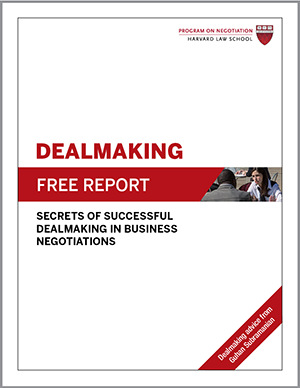
Claim your FREE copy: Dealmaking
Discover how to boost your power at the bargaining table in this FREE special report, Dealmaking: Secrets of Successful Dealmaking in Business Negotiations, from Harvard Law School.
5 Proven Distributive Negotiation Strategies
The following strategies, drawn from Negotiation Genius by Deepak Malhotra and Max H. Bazerman, can help you claim more value in distributive negotiations.
- Focus on the Other Party’s BATNA and Reservation Value. In addition to understanding your own BATNA and reservation point, try to estimate your counterpart’s. Doing so allows you to identify the zone of possible agreement (ZOPA)—the range of outcomes both sides would accept.For instance, if you are willing to pay up to $3,000 for a used car and believe the seller might accept $2,500, the ZOPA lies between $2,500 and $3,000. Negotiators who focus on the other party’s BATNA tend to aim higher and capture more value, according to Malhotra and Bazerman.
- Avoid Making Unilateral Concessions. After initial offers are on the table, resist the urge to make a second concession before your counterpart reciprocates. Unilateral concessions signal weakness and can encourage further demands.If the other party refuses to match your movement, it may be time to pause—or to exercise your BATNA.
- Be Comfortable with Silence. Silence can be one of the most uncomfortable—and most powerful—tools in distributive negotiation. When a counterpart delays responding, negotiators often feel compelled to sweeten the deal prematurely.But silence may be strategic. Speaking when it’s your counterpart’s turn, Malhotra and Bazerman warn, means “you will be paying by the word.”
- Label Your Concessions. Human beings are wired to reciprocate. When we receive a concession, we feel pressure to return the favor. But negotiators also have a tendency to minimize or overlook concessions to escape feelings of obligation.To counter this tendency, explicitly label your concessions. Make clear:
- What you are giving up
- Why it is costly to you
- That it is not something you offer lightly
This framing increases the likelihood that your concession will be acknowledged and reciprocated.
- Make Contingent Concessions. To further reduce ambiguity, consider tying your concessions to specific actions by the other party. For example:“I’m willing to pay more if you can guarantee early delivery.”
Contingent concessions not only protect you from one-sided movement but can also broaden the discussion to include additional issues. In some cases, they even transform a purely distributive negotiation into a more integrative one—creating value in the process.
A Final Thought on Distributive Negotiation
Distributive negotiation is often unavoidable, particularly when resources are limited or price dominates the discussion. Mastering value-claiming strategies doesn’t mean abandoning collaboration—it means knowing how to protect your interests when competition is unavoidable.
Preparation, discipline, and strategic restraint remain the hallmarks of effective distributive negotiators.
What other distributive negotiation tactics have you used effectively?
Claim your FREE copy: Dealmaking
Discover how to boost your power at the bargaining table in this FREE special report, Dealmaking: Secrets of Successful Dealmaking in Business Negotiations, from Harvard Law School.



Must compliment your thought. Being a seasoned trainer in Negotiation, I liked your thought of being comfortable with silence and negotiation dance
Pl share more insight