BATNA Strategy: When to Reveal Your BATNA

A strong BATNA strategy includes determining when to reveal your BATNA, or best alternative to a negotiated agreement. Our six guidelines can help. … Read BATNA Strategy: When to Reveal Your BATNA 
PON – Program on Negotiation at Harvard Law School - https://www.pon.harvard.edu
Negotiation is a deliberative process between two or more actors that seek a solution to a common issue or who are bartering over an item of value. Negotiation skills include the range of negotiation techniques negotiators employ to create value and claim value in their dealmaking business negotiations and beyond. Negotiation skills can help you make deals, solve problems, manage conflicts, and build relationships as well as preserve relationships. Negotiation skills can be learned with conscious effort and should be practiced once learned.
Negotiation training includes the range of activities and exercises negotiators undertake to improve their skills and techniques. Role-play simulations developed from real-world research and negotiation case studies, negotiation training provides benefits for teams and individuals seeking to create and claim more value in their negotiations.
The right skills allow you to maximize the value of your negotiated outcomes by effectively navigating the negotiation process from setup to commitment to implementation.
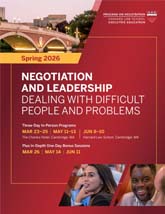
The Program on Negotiation’s Executive Education negotiation training programs include Negotiation and Leadership: Dealing with Difficult People and Problems, the Harvard Negotiation Master Class, and the Harvard Mediation Intensive.
This training allows negotiators to:
A strong BATNA strategy includes determining when to reveal your BATNA, or best alternative to a negotiated agreement. Our six guidelines can help. … Read BATNA Strategy: When to Reveal Your BATNA
Imagine that you’re about to hire someone to provide a service—say, to repair your leaky roof, design a new website for your business, or host an online event. In such everyday negotiation situations, when you receive a price quote, should you try to negotiate a better deal? … Learn More About This Program
Opening offers have a strong effect in price negotiations. The first offer typically serves as an anchor that strongly influences the discussion that follows. In research documenting price anchoring, psychologists Daniel Kahneman and Amos Tversky found that even random numbers can have a dramatic impact on people’s subsequent judgments and decisions. … Read Price Anchoring 101
Real-world negotiation examples can help us learn from the past and avoid repeating others’ mistakes. Here’s a recap of 10 real-world negotiation examples across government and industry that provide negotiation lessons for all business negotiators. … Read 10 Real-World Negotiation Examples
Technology has infiltrated almost every element of our negotiations, as it has almost every aspect of our lives. Negotiation scholars have studied how negotiating via technological media affects the way we negotiate—concluding, for example, that doing business via email can increase misunderstandings and heighten conflict as compared to face-to-face meetings. But the ubiquity of technology … Learn More About This Program
In their revolutionary book Getting to Yes: Negotiating Agreement Without Giving In (Penguin, 3rd edition, 2011), Roger Fisher, William Ury, and Bruce Patton introduced the world to the possibilities of mutual-gains negotiation, or integrative negotiation. The authors of Getting to Yes explained that negotiators don’t have to choose between either waging a strictly competitive, win-lose … Read Six Guidelines for “Getting to Yes”
Positional bargaining may sound like business as usual, but it shouldn’t be. In fact, positional bargaining is typically an ineffective way of reaching an agreement for numerous reasons, including the following three, according to the authors of Getting to Yes. … Read Positional Bargaining Pitfalls
Powerful negotiators can be formidable opponents. That’s in part because their bargaining power in negotiations—such as a high position in a hierarchy, wealth, or a great BATNA (best alternative to a negotiated agreement)—gives them considerable leverage. In addition, powerful individuals tend to demand more for themselves, in violation of fairness norms. Here’s a closer look … Learn More About This Program
Have you ever wondered if your negotiation style is too tough or too accommodating? Too cooperative or too selfish? You might strive for an ideal balance, but, chances are, your innate and learned tendencies will have a strong impact on how you negotiate. … Learn More About This Program
According to Dacher Keltner of the University of California at Berkeley and his colleagues, power in negotiation affects two primary neurological regulators of behavior: the behavioral approach system and the behavioral inhibition system. Powerful negotiators demonstrate “approach related” behaviors such as expressing positive moods and searching for rewards in their environment. … Learn More About This Program

 BATNA
Business Negotiations
Conflict Resolution
Crisis Negotiations
Dealing with Difficult People
Dealmaking
Dispute Resolution
International Negotiation
Leadership Skills
Mediation
Negotiation Skills
Negotiation Training
Salary Negotiations
Teaching Negotiation
Win-Win Negotiations
BATNA
Business Negotiations
Conflict Resolution
Crisis Negotiations
Dealing with Difficult People
Dealmaking
Dispute Resolution
International Negotiation
Leadership Skills
Mediation
Negotiation Skills
Negotiation Training
Salary Negotiations
Teaching Negotiation
Win-Win Negotiations
Lost your password? Create a new password of your choice.
Copyright © 2026 Negotiation Daily. All rights reserved.