


At the negotiation table, what’s the best way to uncover your negotiation counterpart’s hidden interests? Build a relationship in negotiation by asking thoughtful questions—and then listening carefully.
Even if you have already decided to make the first offer and have prepared a range of alternatives, you should begin by asking and listening. Doing so allows you to assess your counterpart’s interests before positions harden. Of course, listening alone is not enough. If your listening style lacks empathy, it is unlikely to elicit honest or complete responses.
A relationship in negotiation is a perceived connection that can be psychological, economic, political, or personal. Whatever its basis, wise leaders—like skilled negotiators—work deliberately to strengthen this connection. Effective leadership, after all, depends on it.
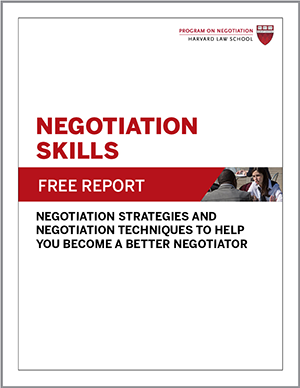
Claim your FREE copy: Negotiation Skills
Build powerful negotiation skills and become a better dealmaker and leader. Download our FREE special report, Negotiation Skills: Negotiation Strategies and Negotiation Techniques to Help You Become a Better Negotiator, from the Program on Negotiation at Harvard Law School.
Positive negotiation relationships matter not because they produce warm feelings, but because they produce trust—a critical mechanism for securing desired actions from others.
Consider that any proposed action, whether raised by a negotiator at the bargaining table or by a leader in a strategy meeting, carries some degree of risk. People tend to view an action as less risky—and therefore more acceptable—when it is suggested by someone they trust.
The Building Blocks of a Strong Relationship in Negotiation
To create a durable relationship in negotiation, four basic building blocks can help you form effective partnerships with the people you lead or negotiate with:
- Two-way communication
- A demonstrated commitment to the other party’s interests
- Reliability
- Respect for others’ contributions
These elements signal trustworthiness long before numbers are exchanged or concessions are made.
How to Build Trust Within a Relationship in Negotiation
People tend to respond to others’ actions with similar actions, as decades of social science research have shown. When others cooperate with us and treat us with respect, we tend to respond in kind. When they appear guarded or overly competitive, we often mirror that behavior.
According to negotiation expert Keith Allred, these reciprocal exchanges can spiral into either vicious cycles—marked by suspicion and contention—or virtuous cycles, where cooperation and goodwill reinforce one another.
This reciprocal nature of trust highlights the value of investing time in rapport building before substantive negotiations begin. Do not assume that a bond can be formed through a few friendly emails alone. Instead, look for opportunities to connect more personally—perhaps by meeting for an informal lunch or scheduling a brief call before formal talks start.
Even a few minutes of genuine small talk can make a meaningful difference.
In her research, Janice Nadler of Northwestern University School of Law found that negotiators who spent just five minutes chatting by phone—without discussing the upcoming negotiation—felt more cooperative, shared more information, made fewer threats, and developed greater trust in a subsequent email negotiation than did pairs who skipped the small talk altogether.
In other words, “schmoozing” and other forms of rapport building do more than smooth social interactions. They can also deliver a meaningful economic payoff.
How have you built trust within a relationship in negotiation? Share your story in the comments.
See Also: How to Deal When the Going Gets Tough – Most business negotiators understand that by working collaboratively with their counterparts while also advocating strongly on their own behalf, they can build agreements and long term relationships that benefit both sides. During times of economic hardship, however, many negotiators abandon their commitment to cooperation and mutual gains. Instead, they fall back on competitive tactics, threatening the other side with “take it or leave it” offers and refusing to accept concessions of any kind.)
See Also: Beware Your Counterpart’s Biases – After a failed negotiation, it’s tempting to construct a story about how the other side’s irrationality led to an impasse. Unfortunately, such stories will not resurrect the deal. In the past, we have encouraged you to ‘debias’ your own behavior by identifying the assumptions that may be clouding your judgment. We have introduced you to a number of judgment biases – common, systematic errors in thinking that are likely to affect your decisions and harm your outcomes in negotiation. These include the mythical fixed-pie, egocentrism, overconfidence, escalation of commitment, the winner’s curse, the influence of vivid data, and so on.
See Also: 15 Top Business Negotiations – Business negotiations tend to have lots of ups and downs—and we can learn from all of them. Here’s a roundup of 15 business negotiations from recent years that offer useful lessons.
See Also: 5 Dealmaking Tips for Closing the Deal – What to do when you’ve done everything right, but you still don’t have an agreement. Here are some tips from Negotiation Briefings to help you close the deal in your next negotiating session at the bargaining table.
Related Negotiation Training Article: Win-Win Negotiation: Managing Your Counterpart’s Satisfaction
Claim your FREE copy: Negotiation Skills
Build powerful negotiation skills and become a better dealmaker and leader. Download our FREE special report, Negotiation Skills: Negotiation Strategies and Negotiation Techniques to Help You Become a Better Negotiator, from the Program on Negotiation at Harvard Law School.
Adapted from “Real Leaders Negotiate” by Jeswald Salacuse for the May 2006 Negotiation newsletter and “How to Build Trust at the Bargaining Table,” first published in the January 2009 issue of Negotiation.




I agree with the points that Jeswald Salacuse is providing. But professional and personal negotiation takes place when you already have a good relationship with your counterparts. How can you say “no” in this kind of relationship without breaking your bond with your counterparts?
I very much agree with the point of view of the article. As a project transfer department, we need to maintain a good customer relationship, improve customer satisfaction, mutual benefit, and common development with customers.
Yes, building relationship is important for business, politics, security et al. The Chinese call it “Guang-Xi” (Relationship built over time). Of course there are connotations that it is used for corrupt practices. Yes, there are instances where buying influence become a problem. It is not only for the Chinese and other Asians but also Americans, Europeans, Arabs etc. Nevertheless, for negotiation building relationship is important, but care must be taken not to go over-board. I have been involved in several negotiations and also consultancy, and I found building relationship is a way to success – Trust is important BUT take care during the process …. time and actions will tell. Adrian Villanueva (Singapore).
I find the information on this website and this article in particular quite exciting, but need to ask more about the group that posts this content. I am struck by how few women are on this panel of experts which investigates and promotes negotiation. To me, women seem more social and reciprocate more readily than men. But at least women are AS GOOD AS men in negotiating. I base my opinion of the negotiation skills of people in general from 21 years as a physician and 17 of those as a psychiatrist. Sociologically, men were originally hunters, women were gatherers. Men valued trust and silence, in order to hunt effectively. Women entrusted each other with the care of their infants. Two hunting buddys have a different level of trust than a mother with a young child.has with the caretaker of her child. Women have traditionally been the go between for their children, with each other, as well as between father and children, and other family disputes. Men have more testosterone than women, and are more easily a rounded to violence as well. I’m not criticizing this group, rather I would like to open this concept of gender equality to this group of negotiators, so they can negotiate a more balanced panel of experts.
Find out what you need to improve in yourself to become more EFFECTIVE!
I agree with the content of the article. The challenge for the parties is deciding the structure of and participants to the negotiation process. My view is there needs to be a desire for an ongoing relationship, appropriate negotiation dynamic and sufficient flexibility for parties to maneuver once an agreement in principle is agreed. I think it is important the psychological process ensures people feel they have some input into the process and not feel entrapped by the outcome. This can be largely overcome by good structure eg executives supporting negotiation process, the negotiation process involving good dynamic eg small equal number of participants from each party, allowing people with most knowledge to negotiate eg people empowered at the lowest level, to prepare solution without third party intervention. Don’t let the feel good cooperation stifle robust discussions.
Good article.
I’m a retired police sergeant now helping communities redefine their relationships with police. I’ve seen many examples of your points within community-police relationships.
Effective, long-term, problem solving relationships between police and communities require the building blocks you recommend.
I agree with you Jeswald! The four points you stated at the end are worth liking and true for maintaining are good relationship.