Conflict resolution success stories rarely make headlines. More often, when disputes arise, parties escalate tensions with hardball tactics—threats, positional bargaining, public grandstanding, and other counterproductive negotiation moves—instead of working to defuse the situation.
And when examples of successful conflict resolution do surface, we often overlook their lessons. We miss the chance to apply them to our own workplace conflict, leadership challenges, or high-stakes negotiations.
In the spirit of learning from real-life examples of conflict resolution, consider this story from Capitol Hill.
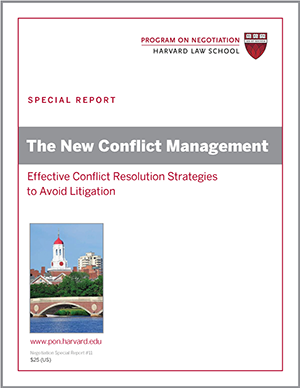
Claim your FREE copy: The New Conflict Management
In our FREE special report from the Program on Negotiation at Harvard Law School - The New Conflict Management: Effective Conflict Resolution Strategies to Avoid Litigation – renowned negotiation experts uncover unconventional approaches to conflict management that can turn adversaries into partners.
Disorder in the Senate: A Shutdown and a Talking Stick
With the U.S. government heading into a shutdown on January 19, 2018, due to the Senate’s inability to agree on a spending bill, roughly 17 centrist Democratic and Republican senators crowded into the Capitol Hill office of Republican senator Susan Collins of Maine.
Their shared goal was clear: negotiate a deal to reopen the government.
Their immediate obstacle? Chaos.
According to reports, voices overlapped. Senators interrupted one another. Momentum stalled. The room, packed beyond capacity, lacked structure.
So Collins reached for an unusual negotiation tool: a Maasai tribal talking stick that Democratic senator Heidi Heitkamp had given her years earlier.
She laid down a simple ground rule:
Only the person holding the stick could speak.
The “talking stick” method, used in various Indigenous tribal councils, ensures that every participant—including quieter or marginalized voices—has an opportunity to be heard. In negotiation terms, it creates structured turn-taking and reduces interruption bias.
In a room full of U.S. senators, that structure mattered.
A Framework Emerges: The Common Sense Coalition
Over the weekend, the bipartisan group—known as the Common Sense Coalition during an earlier 2013 shutdown—shuttled between Collins’s office and the suites of Senate party leaders Mitch McConnell and Chuck Schumer.
The coalition eventually grew to about 25 members—so many that not everyone had a chair.
After debating multiple proposals, the group developed a framework:
- Reopen the federal government
- Secure a commitment from Republican leadership to negotiate in good faith over protections for young undocumented immigrants known as Dreamers
The process was not entirely serene.
At one point, Republican senator Lamar Alexander reportedly tossed the stick toward Democratic senator Mark Warnerafter an interruption, accidentally nicking a glass elephant belonging to Collins. Laughter followed. Collins swapped out the stick for a small rubber ball. Alexander later brought his own basketball to a meeting.
On January 22, 2018, in an 81–18 vote, the Senate passed legislation ending the short-lived shutdown based on the negotiated framework.
Many lawmakers credited Collins—and her talking stick—for restoring order.
“Susan’s office is Switzerland,” Republican senator Lindsey Graham told The New York Times. “It is the one place we can all go and feel good.”
Close Calls, Comic Relief, and Process Discipline
Afterward, Collins displayed the talking stick on CNN and joked to BuzzFeed about how helpful it was in controlling discussion among senators who, unsurprisingly, all wanted to speak at once.
“There were no injuries,” one senator quipped to CNN, though Democratic senator Dick Durbin noted that Graham teased him about “those meetings where they pass the ball around.”
The levity mattered.
Research in conflict management shows that humor and shared ritual can reduce tension, build psychological safety, and promote cooperative behavior. In negotiation settings—especially multiparty negotiations—process control is often more important than persuasion.
The talking stick didn’t change ideology.
It changed the structure of conversation.
And structure often determines outcome.
What Can We Learn from This Conflict Resolution Example?
Some commentators criticized the optics. “Apparently, the United States Senate has devolved to the point where elementary school approaches are needed to maintain civility,” wrote Matthew Rozsa in Salon.
It is also true that, in the months following the agreement, Republican leaders did not ultimately deliver the immigration protections many coalition members had sought. As in many historical conflict resolution examples, progress proved uneven.
Breakthroughs can be temporary.
Still, the short-term success offers valuable negotiation lessons.
5 Negotiation Lessons from the Senate’s Talking Stick
- Process Controls Substance
When discussions become chaotic, imposing simple process rules can unlock stalled negotiations.
- Equal Voice Increases Buy-In
Structured turn-taking prevents dominant personalities from overwhelming others—a common issue in workplace conflict.
- Neutral Space Matters
Collins’s office became perceived as neutral territory—“Switzerland.” Physical and psychological neutrality can transform negotiation dynamics.
- Humor Reduces Tension
Comic relief, even in high-stakes negotiations, builds rapport and diffuses defensiveness.
- Small Tools Can Create Big Shifts
Conflict resolution doesn’t always require sweeping reforms. Sometimes it requires a tossable object and a shared agreement about how to use it.
Why Conflict Resolution Success Stories Matter
We often study negotiation failures. But conflict resolution success stories—even imperfect ones—reveal something essential:
Structure, civility, and mutual restraint can create space for agreement.
In noisy meetings, contentious boardrooms, or multiparty negotiations, it may not take a Maasai talking stick. A marker, a rubber ball, or even a clearly articulated “one person speaks at a time” rule may suffice.
The lesson isn’t about props.
It’s about process discipline.
The next time you find yourself in a noisy debate, try introducing structure. You may not end a government shutdown—but you might end a stalemate.
Have you benefited from a conflict resolution success story—at work or in the news—that reshaped how you approach negotiation?
Claim your FREE copy: The New Conflict Management
In our FREE special report from the Program on Negotiation at Harvard Law School - The New Conflict Management: Effective Conflict Resolution Strategies to Avoid Litigation – renowned negotiation experts uncover unconventional approaches to conflict management that can turn adversaries into partners.