


In business negotiation, a win-win agreement—one that creates value for both sides—may be the ultimate goal. Yet in complex deals, high-conflict settings, or uncertain markets, win-win outcomes can feel frustratingly out of reach.
So how do you create win-win situations in even the trickiest negotiations?
Experts at the Program on Negotiation offer four practical, research-backed strategies that move negotiators beyond positional haggling toward value creation.
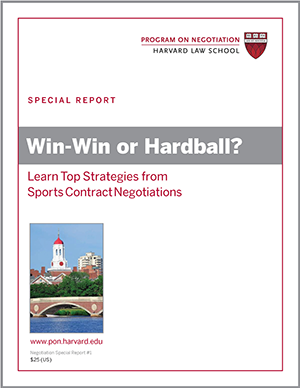
Claim your FREE copy: Win-Win or Hardball
Discover how to handle complicated, high-level business negotiations in this free report, Win-Win or Hardball: Learn Top Strategies from Sports Contract Negotiations, from Harvard Law School.
What Is a Win-Win Negotiation?
A win-win negotiation (also called integrative negotiation) occurs when both parties:
- Improve their outcomes compared to their alternatives (BATNAs)
- Trade across differences in priorities
- Expand the total value available before dividing it
Win-win doesn’t mean equal. It means mutually beneficial.
Here’s how to make that happen.
- Use Joint Fact-Finding to Reduce Conflict Early
When your proposal challenges the status quo, resistance is predictable. Your instinct may be to persuade the other side with data that supports your position.
According to Lawrence Susskind, author of Good for You, Great for Me, that approach often backfires. Presenting one-sided evidence can make you seem dismissive of legitimate concerns.
Instead, try joint fact-finding.
What Is Joint Fact-Finding?
Joint fact-finding is a collaborative process in which:
- Both sides agree on key questions
- Neutral experts are engaged
- Data is gathered transparently
- Findings are evaluated together
Rather than debating whose facts are correct, parties co-create the factual foundation of the negotiation.
This approach is particularly effective when:
- Scientific or technical uncertainty exists
- Public policy or regulatory issues are involved
- Long-term relationships matter
- Trust is fragile
By jointly exploring feasibility and risks before positions harden, negotiators improve their chances of reaching a sustainable win-win contract.
- Create More Value Through Strategic Trades
Another powerful way to create win-win agreements is to look for opportunities to trade across differences.
Most negotiations involve multiple issues—price, timing, scope, risk, service levels, payment terms, publicity, and more. Rarely do both parties value each issue equally.
Susskind suggests three practical steps:
Present Multiple Equivalent Simultaneous Offers (MESOs)
Instead of making a single proposal, present several proposals you value equally. Your counterpart’s reactions reveal hidden preferences.
For example:
- Option A: Higher price, faster delivery
- Option B: Lower price, longer contract
- Option C: Moderate price, premium service support
Ask Questions That Reveal Interests
Move beyond positions. Ask:
- What matters most to you in this deal?
- What constraints are you facing internally?
- How are you measuring success?
Interest-based negotiation uncovers trading opportunities.
Use Hypothetical “What If” Proposals
Test value-creating trades without commitment:
“If we offered a 5% discount, would you extend the contract term?”
“If we assumed more delivery risk, would you accept a higher price?”
These conditional proposals help both sides evaluate potential gains without locking in prematurely.
- Use Contingent Agreements to Manage Uncertainty
Negotiations often stall because parties disagree about the future.
You may believe your team will deliver a project under budget. The client may doubt it. These conflicting predictions create impasse.
A contingent agreement—an “if, then” contract structure—allows parties to bet on their beliefs.
Examples:
- If the project is late, fees decrease.
- If performance targets are exceeded, bonuses are triggered.
- If market demand reaches X, pricing adjusts.
Contingent agreements:
- Reduce risk
- Align incentives
- Transform disagreement into opportunity
How to Structure a Contingent Agreement
- Have both parties write out their expected future scenarios.
- Identify measurable triggers.
- Negotiate appropriate rewards or penalties.
- Document clearly defined metrics and timelines.
When properly designed, contingent agreements create win-win situations by allowing both sides to benefit if their predictions prove accurate.
- Add a Matching Right—But Draft Carefully
A matching right, also known as a right of first refusal, allows a buyer to match or improve upon a competing offer within a specified time frame.
According to Guhan Subramanian, such rights can benefit both sides:
- Buyers stay in the game.
- Sellers explore the market without permanently losing an existing partner.
Matching rights can appear in:
- Real estate transactions
- M&A negotiations
- Supplier agreements
- Licensing deals
Risks to Watch For
Poorly drafted matching rights can create problems:
- Does matching end the bidding process—or trigger a new round?
- Does the right apply only to price?
- How much time does the buyer have to respond?
- Does the clause discourage other bidders from participating?
Never rely blindly on boilerplate language. Carefully negotiate timing, scope, and procedural details to avoid overbidding or constraining competition.
Key Takeaways: Creating Win-Win Outcomes
Creating a win-win agreement requires intentional strategy:
- Collaborate on facts before debating positions.
- Trade across differences instead of arguing over a single issue.
- Use contingencies to bridge future uncertainty.
- Design matching rights carefully to preserve flexibility.
Win-win negotiation is not about being nice. It’s about expanding value before dividing it.
What other strategies have helped you create win-win situations in your negotiations?
Claim your FREE copy: Win-Win or Hardball
Discover how to handle complicated, high-level business negotiations in this free report, Win-Win or Hardball: Learn Top Strategies from Sports Contract Negotiations, from Harvard Law School.



This post offers some excellent insights into creating win-win situations! I particularly appreciated the emphasis on understanding the other party’s needs and building trust. It’s refreshing to see practical strategies that prioritize collaboration over competition in negotiations. Thank you for sharing these valuable tips!
When looking for the win-win, always balance value-added accommodation at low or no cost with long-term interests. Clients tend to embrace the idea of lengthening agreements to avoid the costs associated with RFPs, RFQs, and long bidding cycles.