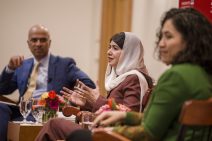
Since the Taliban moved in to fill the power vacuum created by the U.S. withdrawal from Afghanistan in 2021, the rights of women and girls have severely eroded in the country, said activist and Nobel Peace Prize–winner Malala Yousafzai at a March 23 Program on Negotiation (PON) event at Harvard Law School. Today, Afghan women are largely forbidden from working outside their homes, and girls older than 11 are not allowed to attend school.
Claim your FREE copy: International Negotiations
Claim your copy of International Negotiations: Cross-Cultural Communication Skills for International Business Executives from the Program on Negotiation at Harvard Law School.
Yousafzai was visiting PON for a screening of Bread and Roses, a documentary she produced with actor Jennifer Lawrence that shows how the lives of three Afghan women have narrowed since the Taliban regained power. After the screening, PON Faculty Chair Guhan Subramanian interviewed Yousafzai and Gaisu Yari, a policy manager at Yousafzai’s nonprofit, the Malala Fund. (The interview can be watched here.) Subramanian noted that Yousafzai and her husband, Asser Malik, are graduates of one of PON’s negotiation courses, which they signed up for without fanfare.
An advocate for women and girls’ rights from a young age, Yousafzai survived an assassination attempt by the Pakistani Taliban at age 15.
Since retaking control of Afghanistan in 2021, the extremist group has issued more than 230 decrees targeting women and girls, according to Yari. “They are trying to make Afghan women and girls invisible,” she said. The Malala Fund is working to make the type of gender apartheid practiced by the Taliban a crime against humanity under international law.
The fund also supports the education of Afghan girls in secret schools, which are often run by Afghan women in exile. The girls receive lessons on the radio, on TV, and online. “We’re trying everything,” said Yousafzai. Girls are passing on their newfound knowledge to other girls in their communities, acting as “students and teachers at the same time.”
A Call for Support
Yousafzai noted that “women have been excluded from peace talks between the Taliban and the United States. The Taliban demanded that women could not be in those rooms, and the world accepted that.”
She called on international negotiators to make women’s rights and girls’ education a nonnegotiable condition in any conversations with the Taliban and to ensure that Afghan women and girls are represented at the negotiating table. “You cannot determine the future of a country when half of the population is held back,” she said.
The Taliban’s infringements on women’s rights are often treated as a cultural or religious issue. But, noting that other Muslim countries do not impose such restrictions, Yousafzai asserted that there is “nothing Islamic” about the Taliban mindset: “It’s their patriarchy, their misogyny.” She encouraged other governments to treat the Taliban’s negotiating conditions as a human rights issue, not a religious one.
Governments contribute to the problem when they ignore it, according to Yousafzai. When the Taliban foreign minister visited India, she noted, his delegation excluded women journalists from a press conference. “They aren’t just making Afghan women invisible,” she said. “The more we look away from it, we normalize it.”
“Afghan women are very brave, resilient, and courageous, but this is a call for more support and global solidarity,” said Yousafzai. “Afghan women should not be alone in this.”
Standing Up for Human Rights
“Your support is way more powerful than you can imagine,” said Yousafzai. “So, let’s challenge ourselves to protecting human rights.”
Students, lawyers, and others can educate themselves about the Taliban’s erosions of women’s and girls’ rights online at the Afghanistan Justice Archive. The archive documents Taliban decrees and how they affect women and girls. In addition, those seeking to help can lobby policymakers to “center the voices of Afghan women and girls,” Yari said.
Subramanian asked Yousafzai what Afghan men were doing to try to stand up for women’s rights. It’s challenging for men to come forward, she said, as they can be punished for not “controlling their women.” Further, because there is no judicial system in Afghanistan, citizens cannot defend themselves against unjust charges. But some men, she said, were finding ways to speak out through storytelling, art, and music.
The ban on girls’ education and work for women in Afghanistan should serve as a “wake-up call to reflect on how few protections there actually are for women and girls” worldwide, said Yousafzai. The Malala Fund gives grants to local education organizations in many countries, including Pakistan, Nigeria, Ethiopia, and Brazil. “We have changed laws in so many places, increased the budget in so many places, and reduced dropout rates.
“I believe in the power of one voice starting a change,” said Yousafzai, “but I believe even more in the power of collective work and activism. We can really shift the narrative when we join hands.”
Claim your FREE copy: International Negotiations
Claim your copy of International Negotiations: Cross-Cultural Communication Skills for International Business Executives from the Program on Negotiation at Harvard Law School.