
Harvard Negotiation Master Class
Advanced Strategies for Experienced Negotiators
Monday to Friday, April 13–17, 2026

Take Your Negotiation Skills to the Master Level
The Harvard Negotiation Master Class is the most advanced program offered by the Program on Negotiation, and is newly expanded to include five days of expert, interactive instruction. This transformational in-person learning experience is designed for professionals like you: strong negotiators who are ready to push their skills to the highest level.
With unprecedented access to renowned experts from Harvard Law School, Harvard Kennedy School, and the Massachusetts Institute of Technology, you’ll enhance your ability to shape deals, salvage relationships, and achieve better negotiation outcomes.
The program’s intimate format fosters deep engagement with faculty, meaningful connections with accomplished peers, and memorable after-hours events. Participation is strictly limited to 42 experienced professionals who have completed prior negotiation training, creating a setting that is both rigorous and deeply personal.
Through real-world case studies and high-stakes simulations, you’ll apply and refine advanced negotiation techniques—and emerge with a true command of the game and how it’s played.
AGENDA
Join the Ranks of Master Negotiators
Mastering the art of negotiation is a lifelong journey. The Harvard Negotiation Master Class offers the rare opportunity to step away from your day-to-day responsibilities to self-reflect and focus on developing a competency that will serve you for the rest of your professional life. After five intensive days, you will emerge a highly confident negotiator who truly understands the game—and loves to play it.
Agenda
DAY 1: Monday, April 13, 2026
8:00 a.m. Registration and Breakfast Buffet
MORNING
THE FIRST 180 SECONDS: CREATING IMPACTFUL OPENINGS
8:30 a.m. – 12:00 p.m. ET | Led by Brian Mandell
As a seasoned negotiator, you know how important it is to come prepared for the full arc of a negotiation. Research shows, however, that you should spend just as much time preparing for the first 180 seconds of a negotiation encounter as you do for the rest. That’s because the outcomes of the very first interactions—where negotiators act upon thin slices of information—disproportionately affect overall success. Moreover, when things go awry in these critical first few moments, it can be difficult to recover lost ground.
In this session, you’ll learn how to effectively set the tone and agenda, create rapport, and build momentum at the outset of a negotiation. Additionally, you will enhance your ability to:
- Prepare for negotiation by evaluating sources of power and assessing barriers to negotiated agreement
- Identify shared, opposing, and tradeable interests
- Set a firm, collaborative tone, shape expectations, and propose a well-sequenced agenda that aligns with your priorities
- Generate momentum and a trust-building conversation by sharing information
- Invoke fairness standards to avoid early missteps likely to trigger an impasse or motivate potential spoilers
- Ask probing, clarifying, and investigative questions in a nondefensive manner
- Make opening offers grounded in high aspirations that signal a robust BATNA
- Leverage your professional reputation to encourage concessions
- Maintain emotional control and defend against hard bargaining tactics by reframing unacceptable early moves or offers designed to destabilize negotiators
- Establish the groundwork for writing the other side’s victory speech by focusing on addressing their underlying interests and concerns
- Signal your attentiveness to geographic and organizational cross-cultural differences
AFTERNOON
THE LAST 180 SECONDS: CLOSING THE DEAL WITH CONFIDENCE
1:30 pm–5:30 pm | Led by Brian Mandell
You’ve made it to the end of a negotiation—are you ready for what comes next? The goal of this session is to prepare you to effectively manage those f inal minutes in a negotiation when an important, high-consequence deal hangs in the balance and any missteps could quickly undermine parties’ trust and confidence, resulting in the deal unraveling. Navigating this “last mile challenge” compels negotiators to multitask—to maintain discipline, focus, and resilience, while simultaneously addressing the substantive and relationship dimensions of the negotiation needed for crafting a sustainable, value-creating deal.
In this session, you’ll learn how to:
- Assess willingness and readiness to close the deal
- Overcome psychological and bureaucratic decision-making barriers to commitment making and closing the deal
- Confront hard bargaining “take it or leave it” and “yes, but” tactics
- Write your counterpart’s victory speech to reduce hesitancy and resistance to closing the deal now
- Use the negotiator’s pause to better control the rate and scope of making any final concessions
- Deal with an impasse stemming from the last-minute introduction of new preconditions prior to signing the deal
- Distinguish between hard and soft closings and when to use them to maximize your leverage
- Limit gratuitous bargaining and conflict escalation
- Leverage deadlines and time urgency
- Build commitment to deal implementation
- Frame and reframe offers to scope and refine the deal components
- Use dispute resolution mechanisms to safeguard against a counterpart’s noncompliance with commitments to deal implementation
DAY 2: Tuesday, April 14, 2026
8:00 a.m. Breakfast Buffet
MORNING
ADVANCED DIFFICULT CONVERSATIONS—BUILDING (AND RE-BUILDING) TRUST
8:30 am–12:30 pm | Led by Sheila Heen
You can’t avoid difficult conversations. But you can learn to make them less painful—and more productive. In this session, we will take a look at three suites of skills that advanced negotiators can use to diagnose challenges and adjust their approach when things get tough. We will also draw on the Difficult Conversations framework for engaging tough issues in difficult circumstances, and under time pressure.
The centerpiece of this session will be preparing for and conducting a negotiation in which frustration, mistrust, time pressure, grave consequences, and the need for complex problem solving come together to create a perfect storm.
Alongside your peers, you will have the opportunity to:
- Face a counterpart who is impatient, distracted, and in a position of authority, and with whom you have some relationship history
- Work with a teammate in order to learn from one another’s negotiation approach and think about how to best prepare together as a team
- Integrate sometimes conflicting information from multiple sources
- Clarify your own purposes and priorities
- Plan how to open the conversation and how to frame the problem
- Respond to unexpected surprises or resistance
- Draw on your diagnostic skills to make good choices in the moment as the negotiation unfolds
- Practice advanced skills that will enable you to repair trust, build a stronger working relationship, and solve problems together
AFTERNOON
ANALYZING OBJECTIVE AND SUBJECTIVE VALUE IN NEGOTIATION
1:30 pm–5:30 pm | Led by Jared Curhan
Conventional wisdom holds that the economic value of a deal is the yardstick by which negotiation performance should be measured. In contrast, how you feel afterward is considered to be a fleeting emotion irrelevant to bottom-line performance. Yet recent research dispels this notion, suggesting instead that the impression you make on your negotiation counterparts—what’s known as subjective value—often holds more weight than the monetary, or objective, value of a deal.
Led by Jared Curhan, this session will review basic concepts you will have learned in prior negotiation training, such as how to create and claim value. Then, you will delve into the more advanced topic of subjective value, which includes feelings about the outcome, oneself, the process, and the relationship. By doing so, you will learn how to foster subjective value while preserving objective value.
Core to this session is a scored negotiation simulation and online system for evaluating negotiation performance in real time. After the simulation, you will receive extensive feedback on multiple dimensions of negotiation performance and be measured on the following criteria relative to your peers:
- Value created
- Value claimed
- Subjective value
By identifying your strengths and weaknesses, you will learn how to maximize both objective and subjective value in negotiation and gain greater self awareness as you understand how impressions affect your negotiation counterparts.
DAY 3: Wednesday, April 15, 2026
8:00 a.m. Breakfast Buffet
MORNING
THE ART OF NEGOTIATION: LESSONS FROM THE C-SUITE
8:30 am–12:30 pm | Led by Guhan Subramanian
Complex negotiations shape the future of organizations, from billion-dollar mergers to transformative partnerships. The stakes are high, the dynamics are unpredictable—and the leaders who excel are the ones who know how to blend strategy, influence, and timing to drive the best outcomes.
In this compelling session, PON Faculty Chair Guhan Subramanian takes you inside the world of C-Suite negotiations with a leading CEO. Together, they’ll explore the challenges and opportunities that arise when leadership, strategy, and negotiation intersect.
Drawing on real-world examples and Professor Subramanian’s extensive research, this session will equip you with practical insights for navigating complexity and negotiating with impact at the highest levels.
Specifically, you’ll learn how to:
- Apply negotiation strategies across a range of scenarios—from home deals to corporate mergers
- Make game-changing moves that can help you set up, rearrange, and close deals
- Remain confident and in control during high-stakes negotiations
- Build leverage and influence when traditional playbooks fall short
This session is designed to be wide-ranging and interactive—giving you an inside look at how top leaders think about negotiation and dealmaking, and the tools you need to secure better deals.
AFTERNOON
SYNCHRONIZING INTERNAL AND EXTERNAL NEGOTIATIONS: UNLOCKING INFLUENCE IN COALITIONS AND MULTIPARTY CONTEXTS
1:30 pm–5:30 pm | Led by Morgan Franklin and Deanna Parrish
PART 1: Behind the Table: Navigating Teams and Coalitions
Designed for leaders navigating today’s complex organizational environments, this dynamic two-part session will equip you with the frameworks and tools you need to map team networks, build effective coalitions, and strategically manage influence across and behind the negotiation table.
In part one, through a mix of interactive exercises and guided discussions, you’ll learn how to diagnose formal and informal roles within teams, map stakeholder interests, and plan sequential negotiation strategies for major internal initiatives. You’ll also discover how to overcome barriers including turf wars, trust deficits, and power asymmetries, applying interest-based solutions to deliver stronger outcomes.
Specifically, in this program, you will learn how to:
- Distinguish internal from external negotiations, and recognize the unique challenges and opportunities of each
- Navigate principal-agent tension, including questions of authority, trust, and rebuilding trust when it breaks down
- Map team dynamics, identify key influencers, and prepare to lead more effective group negotiations
- Build alliances within your organization, understand stakeholder interests, and sequence your approach to gain buy-in for key initiatives
- Apply strategies to address conflicts, silos, and trust issues
- Align teams and coalitions to manage complex negotiations, creating value and strengthening relationships
DAY 4: Thursday, April 16, 2026
8:00 a.m. Breakfast Buffet
MORNING
SYNCHRONIZING INTERNAL AND EXTERNAL NEGOTIATIONS: UNLOCKING INFLUENCE IN COALITIONS AND MULTIPARTY CONTEXTS
8:30 am–12:30 pm | Led by Morgan Franklin and Deanna Parrish
PART 2: Across the Table: Managing Multiple Stakeholders
In part two, capstone learning comes alive in a simulated, multiparty labor negotiation, where you’ll have the chance put new strategies into practice in a realistic, high-stakes environment.
You’ll step into the roles of union and management representatives at American Phone Company, where years of strained relations and a contentious strike have set the stage for a challenging negotiation. With critical issues such as wages, job security, and medical benefits on the line, you’ll need to balance competing interests, manage team dynamics, and work under pressure to reach an agreement.
Over the course of this session, you will:
- Review general background and confidential instructions to understand your roles, priorities, and constraints
- Meet with your team to align strategies, identify interests, and plan your approach
- Bargain directly with the opposing side, testing your ability to advocate, compromise, and think creatively in the face of opposition
- Reflect on the negotiation process, outcomes, and key lessons from applying these skills in real-world contexts
You’ll come away from the two-part session with a sharpened toolkit for leading internal collaboration, navigating complex multiparty negotiations, and building lasting agreements—and professional relationships.
AFTERNOON
MULTIPARTY NEGOTIATIONS: MANAGING THE CHALLENGES AND OPPORTUNITIES OF GROUP DECISION MAKING
1:30 pm–5:30 pm | Led by Alonzo Emery
PART 1
Most decisions are made with input from a variety of stakeholders. As the number of parties at the table grows, negotiation challenges—as well as opportunities—start to multiply. Additional parties create more opinions about the “right” process to follow and which issues should be discussed. Working to satisfy various interests and perspectives can reduce the zone of possible agreement, but it can also reveal value-creating solutions. This session explores how advanced negotiators can manage the many challenges of multiparty negotiations while also leveraging opportunities to improve relationships and create greater value.
Specifically, you will learn to:
- Diagnose and solve for critical challenges in multiparty negotiations
- Identify key stakeholders and decide which to include at the table
- Focus on value creation in the face of multiple, conflicting interests
- Maintain relationships while managing diverse personalities and perspectives
- Design a robust negotiation process that will keep your group moving forward and on task
- Establish group norms to help guide you through your deliberations
- Set realistic deadlines that will keep your group centered on its purpose
- Divide responsibilities so that each group member fills a meaningful and useful role
- Determine which decision-making norms work best for a given topic and a particular group
DAY 5: Friday, April 17, 2026
8:00 a.m. Breakfast Buffet
MORNING
MULTIPARTY NEGOTIATIONS: MANAGING THE CHALLENGES AND OPPORTUNITIES OF GROUP DECISION MAKING
8:30 am–12:30 pm | Led by Alonzo Emery
PART 2
By participating in a fast-paced multiparty negotiation simulation, you’ll put many of the skills you’ve honed throughout the program to the test. During this realistic negotiation, you’ll have the opportunity to:
- Improve your ability to manage multiple parties through a structured approach
- Break free from old patterns and focus on creative problem solving
- Find new ways to create value by “expanding the pie”
- Manage conflicting preferences and priorities to build consensus
- Explore the merits and pitfalls of breaking away from the larger group to engage in one-on-one negotiation
- Build coalitions to strengthen your influence and expand your leverage
- Use effective frameworks to manage the process and any heightened emotions
After the simulation concludes, you’ll engage in a structured debriefing session to reflect on the experience. Together, you’ll analyze which strategies proved most effective, explore areas that could be refined, and examine the dynamics that shaped the outcome.
This debrief is designed to not only reveal meaningful insights from your own experience but also highlight practical lessons you can apply to the complex, multiparty negotiations you will lead in the future.
Bring Your Challenges
In the final phase of the session, you’ll be invited to share real-life negotiation challenges and receive actionable advice from experts and peers. You’ll walk away with a new toolkit of strategies and frameworks you can apply to your next multiparty negotiation.
AFTERNOON
DEBRIEF AND WRAP-UP
1:30 pm–2:30 pm | Led by Brian Mandell
This final session gives you the chance to step back and reflect on the week’s key themes and insights, reinforcing the core concepts of advanced negotiation practice.
During the debrief, you will:
- Reflect on your experiences throughout the program
- Exchange perspectives and strategies with your peers
- Identify personal takeaways and areas for continued growth
- Discuss how the techniques you learned can be translated into real-world negotiations
- Develop a roadmap for applying your learning and driving lasting impact in your career
FACULTY

Brian Mandell
Brian Mandell is the Mohamed Kamal Senior Lecturer in Negotiation and Public Policy at the Harvard Kennedy School, a faculty associate at the Center for Public Leadership, Director of the Harvard Kennedy School Negotiation Project, and Vice Chair of Executive Education for the Program on Negotiation at Harvard Law School’s Executive Committee.
He is a preeminent teacher and curriculum designer at the Harvard Kennedy School, where he leads an innovative, intensive annual workshop course on advanced multiparty negotiation and conflict resolution.
Professor Mandell refined his case teaching methods in international affairs as a Pew Faculty Fellow and subsequently trained faculty from across the United States in case-method pedagogy with a special emphasis on teaching and writing cases for internationa security studies.
He is a multiple recipient of the School’s Most Influential Course Award, the Manuel C. Carballo Award for Excellence in Teaching, and the Dean’s Award for Teaching Excellence. Through the Negotiation Project, Mandell designs and produces multiparty negotiation exercises that focus on the challenges of cross-boundary collaboration.
Additionally, he is designing and developing curriculum material for graduate students and congressional staffers in the Hewlett Foundation’s Madison Initiative on strengthening bipartisan legislative negotiation in Congress.

Sheila Heen
Sheila Heen is the Thaddeus R. Beal Professor of Practice and serves as a Deputy Director of the Harvard Negotiation Project, where she has been developing negotiation theory and practice since 1995. Heen also teaches executive education programs for and serves on the Executive Committee of the Program on Negotiation at Harvard Law School.
Heen specializes in particularly difficult negotiations — where emotions run high and relationships are strained. She is a co-author of two New York Times bestsellers, Difficult Conversations: How to Discuss What Matters Most (with Douglas Stone and Bruce Patton, 3rd ed. Penguin 2023) and Thanks for the Feedback: The Science and Art of Receiving Feedback Well (Even When It’s Off-Base, Unfair, Poorly Delivered, and Frankly, You’re Not in the Mood) (with Douglas Stone, Viking/Penguin 2014). She has written for the Harvard Business Review and the New York Times as a guest expert and as a Modern Love columnist.
Heen is also a founder of Triad Consulting Group, a corporate education and consulting firm that serves clients on six continents. Her corporate clients have included Pixar, Hugo Boss, the NBA, and the Federal Reserve Bank, to name a few.
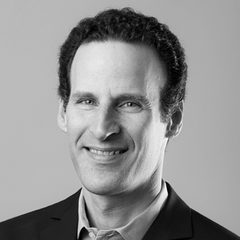
Jared Curhan
A recipient of support from the National Science Foundation, Jared Curhan specializes in the psychology of negotiation and conflict resolution. Notably, he has pioneered a social psychological approach to the study of “subjective value” in negotiation—that is, the social, perceptual, and emotional consequences of a negotiation. Deeply committed to education at all levels, Curhan received Stanford University’s Lieberman Fellowship for excellence in teaching and university service, as well as the institute-wide teaching award presented annually by the Graduate Student Council of the Massachusetts Institute of Technology.
He is the founder of the Program for Young Negotiators Inc., an organization dedicated to promoting negotiation training in primary and secondary schools. Curhan’s acclaimed book Young Negotiators has been translated into Spanish, Hebrew, and Arabic and used around the world to train children to achieve their goals without the use of violence.
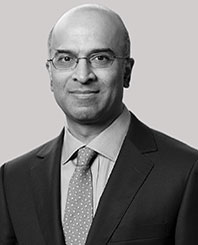
Guhan Subramanian
The first person in the history of Harvard University to hold tenured appointments at both Harvard Law School (HLS) and Harvard Business School (HBS), Guhan Subramanian is a consummate educator, dealmaker, and leader. As the chair of the Program on Negotiation, he spearheads negotiation and mediation training programs for the more than 3,000 professionals who attend every year. At HLS, Subramanian teaches courses on negotiation and corporate law. At HBS, he teaches in several executive education programs, including Strategic Negotiations, Changing the Game, Making Corporate Boards More Effective, and Mergers and Acquisitions, of which he is faculty chair.

Morgan Franklin
Morgan is a Clinical Instructor for the Negotiation & Mediation Clinical Program (HNMCP) and Lecturer on Law in the Negotiation Workshop at Harvard Law School.
Her interest in dispute resolution and negotiation stems from an interest in cognitive and behavioral science paired with her belief in the field’s importance in addressing societal challenges. Since her involvement with negotiation theory as a student she’s been able to experience how transformative gaining the skill set taught by the clinic can be, both professionally and personally.
Morgan holds a B.A. in Political Economy, magna cum laude, from Tulane University and is originally from Shreveport, Louisiana. She received her J.D. from Harvard Law School in 2017 and is a member of the Maryland Bar. As a law student she was fortunate to take classes related to problem solving in various contexts, from administrative organizations to direct services.

Deanna Pantín Parrish
Deanna Pantín Parrish is Lecturer on Law at Harvard Law School and a Clinical Instructor at the Harvard Negotiation and Mediation Clinical Program.
Prior to returning to Harvard, Ms. Parrish worked as the Principal Consultant of CMA Consulting Group, an international firm based in Melbourne, Australia that offers strategic consulting and corporate education on dispute resolution and negotiation to clients across the Asia-Pacific region. In this role, Ms. Parrish spearheaded the design and development of bespoke dispute resolution and learning solutions for over 2,000 professionals in law, higher education, organizational development, finance, technology, and government.

Alonzo Emery
Alonzo Emery is a lawyer, mediator, and facilitator who has taught negotiation at Harvard for over a decade. They work with leaders across industries to develop effective conflict management strategies and engage in meaningful cross-cultural dialogue. In this capacity, Emery has led projects and workshops for Salesforce, Hewlett Packard, HSBC, the U.S. Department of Justice Community Relations Service, the National Institutes of Health, the Asian Development Bank, the Natural Resources Defense Council, and the JSW School of Law in the Kingdom of Bhutan, among many others.
Prior to joining Harvard Law School and the Harvard Graduate School of Education, Emery was on faculty at Renmin University of China Law School in Beijing, where they launched the Renmin University Disability Law Clinic, the first law school clinic in China dedicated exclusively to serving persons with disabilities. They have additionally taught at Georgetown University and the University of California, Berkeley.
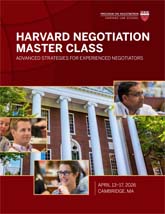
The Harvard Negotiation Master Class was an enriching experience for me. Through immersive case studies and expert-led sessions, it helped my ability to navigate complex negotiations, resolve disputes, and foster collaborative outcomes.”
— Latifat Folashade Yusuff
Head, Commercial Law, NNPC Limited
Regional Director, Africa, Association of International Energy Negotiators (AIEN)

Dinner at the Harvard Faculty Club Featuring Jared Curhan on AI and Negotiation
Tuesday, April 14, 2026 | 6:00 pm–9:00 pm
Join us for dinner and conversation at a historic Harvard institution, which will provide the perfect backdrop for exploring one of the most defining topics of our time: AI.
A leading authority in the space, Jared Curhan will discuss how today’s AI-powered technologies are transforming the way we prepare for negotiations—helping professionals sharpen their strategies and achieve better outcomes.
WHO SHOULD ATTEND
The Harvard Negotiation Master Class attracts a diverse group of participants—all of whom are proficient negotiators who wish to take their skills to the next level.
To be eligible for the Harvard Negotiation Master Class, applicants must demonstrate at least 10 years of negotiation experience, as well as a prior course with PON or a comparable program centered on mutual gains bargaining.

Closing Reception at Bar Enza
Thursday, April 16, 2026 | 6:00 pm
As the Harvard Negotiation Master Class draws to a close, we invite you to join us for a reception that will serve as both a celebration and a moment of reflection. Over drinks and hors d’oeuvres, we will acknowledge outstanding contributions and hear closing remarks from our faculty and leadership. This is your opportunity to consider how you’ll carry the fresh insights, strategies, and relationships you’ve gained into your organization and beyond.
The PON Negotiation Master Class was an inspiring experience for me. The faculty and staff are passionate about giving us the tools to be effective in our professional and personal lives. During one of the conference breaks I made a call and settled a case using one of the lessons I had learned, and I realized the program paid for itself 100 times over after just the first day.”
— Arthur W. Stevens, III
Attorney and Partner, Black, Chapman, Petersen and Stevens
Attending Harvard Law School PON’s Master Class was a turning point experience in my career. I am overwhelmed by the amount of useful data, information, and lessons that will definitely enhance my performance as a transactional lawyer. Moreover, the material I will take home will be a powerful tool I can use in real life negotiations.”
— Marcelo Pupe Braga
Partner, PMZ Advogados
PAST PARTICIPANTS




…and many more!
Excellent program where you get to meet and learn directly from the legends that write the books we have all read. I would go again just to experience new students and keep developing my skillset. Recommend to anyone who uses negotiation, which spoiler, is all of us every day!”
— Mike Clawson
Digital Catalyst, Adobe
The entire PON program, of which I have participated four times this year, is truly outstanding in all aspects. Well led, well presented, with enduring results in the real world.”
— Phillip Thomas
CEO and Founder, Boston Business Group, LLC